ZK Rollups Define 2026 Scaling
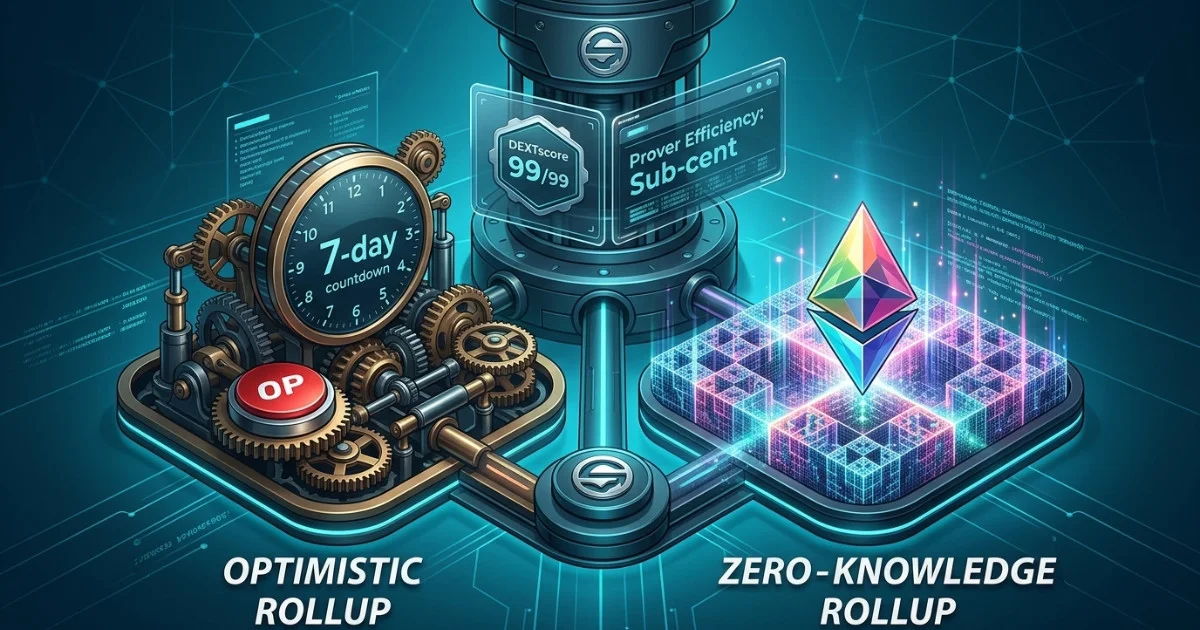
Zero-knowledge (ZK) rollups have emerged as the dominant Layer 2 architecture for Ethereum scaling in 2026. While optimistic rollups like Arbitrum and Optimism gained early traction by relying on dispute windows, ZK rollups have shifted the paradigm by generating cryptographic validity proofs for every batch of transactions. This technical distinction eliminates the need for multi-day fraud proofs, offering instant finality that institutional capital and high-frequency applications demand.
The friction that once hindered ZK adoption has nearly vanished. As noted in recent market analyses, the user experience on leading ZK platforms is now indistinguishable from Layer 1 networks, with gas costs significantly reduced and transaction speeds increased. Ethereum co-founder Vitalik Buterin has identified ZK-rollups as the likely main Layer 2 solution for the coming years, citing their superior scalability and security guarantees compared to optimistic approaches.
This transition is not merely technical but economic. By moving the computational heavy lifting off-chain and verifying it on-chain with succinct proofs, ZK rollups allow Ethereum to process thousands of transactions per second without congesting the mainnet. The following chart illustrates the market context for this shift, showing Ethereum's price action as the underlying asset for these scaling solutions.
The dominance of ZK rollups signals a maturation of the Layer 2 ecosystem. As the technology matures, we are seeing a consolidation of projects that prioritize validity over speed alone, setting the stage for a more robust and scalable decentralized financial infrastructure.
How ZK proofs secure transactions
Zero-knowledge rollups secure transactions by generating a cryptographic validity proof for every batch of off-chain computations. Instead of relying on a dispute period to catch errors, these networks submit a succinct proof to the Ethereum mainnet that mathematically guarantees the state transition is correct. This mechanism replaces the challenge windows of optimistic rollups with immediate finality, allowing the network to reject invalid batches instantly without waiting for a seven-day fraud window.
The two primary cryptographic frameworks behind this security are zk-SNARKs and zk-STARKs. zk-SNARKs (Succinct Non-Interactive Arguments of Knowledge) produce extremely small proofs that verify quickly, making them ideal for high-throughput environments where gas costs on Ethereum are a primary constraint. However, they rely on a trusted setup ceremony, which introduces a theoretical security risk if the initial parameters are compromised. zk-STARKs (Scalable Transparent Arguments of Knowledge) eliminate the need for a trusted setup and offer quantum-resistant security, but their proofs are larger and more computationally intensive to generate.
The choice between these proof systems often dictates the trade-off between speed, cost, and long-term security assumptions. As the zkEVM landscape matures in 2026, projects are increasingly adopting hybrid approaches or migrating to STARK-based systems to address the scalability limitations of SNARKs while maintaining the robust security guarantees required for high-stakes financial applications.
Comparing Top General-Purpose zkEVMs
The race to scale Ethereum has consolidated around three dominant general-purpose zkEVMs: zkSync Era, Polygon zkEVM, and Linea. Each project leverages zero-knowledge proofs to bundle transactions off-chain, but their approaches to EVM equivalence and ecosystem maturity diverge significantly. For institutional players and developers, the choice is not merely about throughput; it is about alignment with existing infrastructure and liquidity depth.
zkSync Era prioritizes strict EVM equivalence, allowing Solidity smart contracts to deploy with minimal modification. This focus has attracted a high volume of decentralized finance (DeFi) applications seeking low-cost execution without rewriting codebases. Polygon zkEVM, backed by the established Polygon ecosystem, offers a balance between full EVM compatibility and optimized performance, leveraging its existing network effects to onboard enterprise-grade applications. Linea, developed by ConsenSys, emphasizes a "full EVM equivalence" model that ensures binary compatibility with Ethereum, facilitating the migration of complex institutional workloads.
The following comparison highlights the structural differences in TVL, transaction throughput, and compatibility models that define their current market positions.
| Project | TVL (Est.) | Avg. Tx Speed | EVM Compatibility |
|---|---|---|---|
| zkSync Era | $1.2B | ~2-3s finality | Full EVM |
| Polygon zkEVM | $850M | ~15s finality | Full EVM |
| Linea | $600M | ~12s finality | Full EVM |
Liquidity distribution remains the primary differentiator. zkSync Era currently leads in total value locked, driven by its early mover advantage in the consumer DeFi sector. Polygon zkEVM benefits from the broader Polygon brand recognition, attracting hybrid applications that require both scalability and enterprise-grade security guarantees. Linea’s growth is closely tied to the MetaMask ecosystem, providing a unique distribution channel for user acquisition.
For finance professionals evaluating these layers, the technical claims of "full equivalence" must be weighed against real-world gas fee volatility and bridge security audits. The table above provides a snapshot of current metrics, but the true test lies in the sustained performance of these networks during high-volume market events.
Starknet and High-Performance Alternatives
Starknet diverges from the standard Ethereum Virtual Machine (EVM) model by utilizing Cairo, a domain-specific programming language designed for zero-knowledge proofs. This architectural choice allows for significantly higher throughput compared to EVM-compatible rollups, as Cairo natively supports advanced cryptographic operations without the overhead of EVM simulation.
While projects like zkSync and Scroll prioritize EVM equivalence to ensure easy migration for existing developers, Starknet’s approach demands a shift in development methodology. This tradeoff sacrifices immediate compatibility for raw performance, making it a preferred choice for applications requiring massive parallelization and complex state transitions.
The market response to this high-performance infrastructure is reflected in token valuation. Monitoring STARK provides insight into investor confidence in non-EVM zkEVM architectures versus traditional EVM scaling solutions.
Choosing the Right ZK Rollup for 2026
Selecting a ZK rollup is a strategic allocation of capital and engineering resources. The decision hinges on three non-negotiable vectors: EVM equivalence depth, liquidity availability, and developer tooling maturity. A mismatch here creates friction that no amount of marketing can overcome.
Distinguish between full EVM equivalence and EVM compatibility. Full equivalence allows smart contracts to deploy and execute without modification. Compatibility often requires code refactoring, introducing deployment risk and potential state divergence. Prioritize projects with audited, full-equivalence stacks for complex DeFi applications.
Liquidity is the lifeblood of any rollup. Evaluate the total value locked (TVL) and daily trading volume on centralized and decentralized exchanges. Thin liquidity leads to high slippage and MEV extraction, eroding returns. Use the ETH price chart below to gauge the broader market sentiment influencing capital flows into these ecosystems.

Robust SDKs, comprehensive documentation, and active community support reduce time-to-market. Test the developer experience by deploying a simple contract. If the tooling is fragmented or poorly maintained, your engineering team will spend months fighting infrastructure rather than building product.
A rigorous evaluation of these factors ensures your infrastructure choice aligns with long-term scalability and user experience goals.
Bitcoin Privacy and Ethereum Price Outlook
Zero-knowledge technology is reshaping how we view asset privacy and market valuation. While Bitcoin’s native protocol does not currently support ZK proofs, the underlying mathematics offer a path to private transactions. Meanwhile, Ethereum’s trajectory remains tied to broader institutional adoption of its Layer 2 infrastructure.
Does Bitcoin Use ZKP?
Bitcoin’s base layer relies on elliptic curve cryptography and Schnorr signatures, not zero-knowledge proofs. However, ZKPs can be applied in secondary layers or sidechains to enable private transactions. A ZK proof can verify that a user has sufficient funds without revealing their wallet balance or transaction history. This distinction separates Bitcoin’s public ledger model from the privacy-first designs of newer chains. For a deeper look at how ZKPs function in crypto contexts, see Meegle’s guide on ZKP in Bitcoin.
Can Ethereum Reach $100k in 2026?
A $100,000 Ethereum price is not impossible, but it remains extremely improbable without a structural shift in global finance. For that milestone to materialize, governments, corporations, and markets would need to integrate Ethereum's rails as standard infrastructure. The friction of current L1 scaling is fading, with ZK and optimistic rollups carrying the bulk of onchain activity by 2026. Yet, price action depends on macro liquidity, not just technological utility.
No comments yet. Be the first to share your thoughts!