
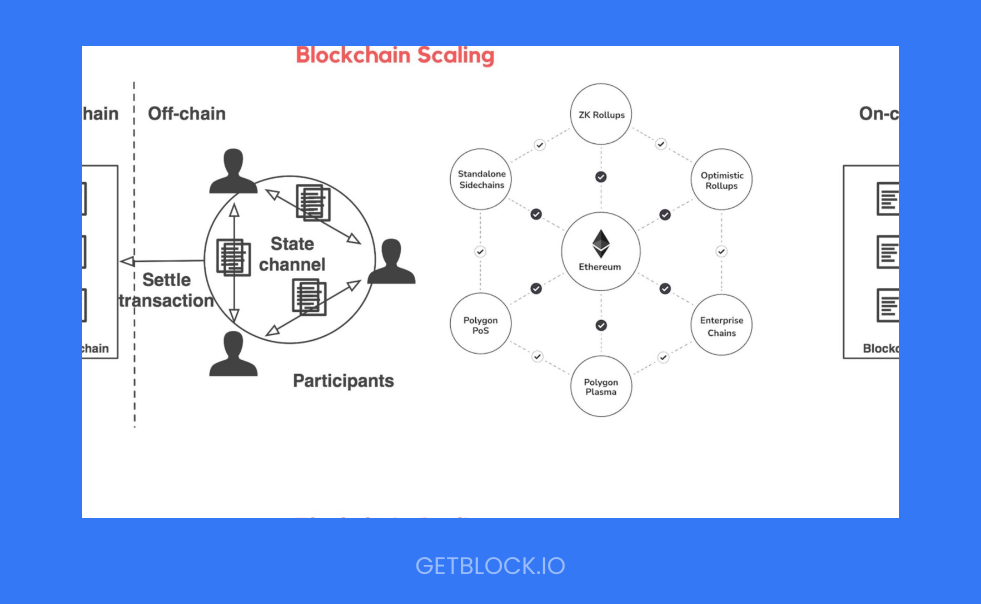
ZK rollups drive enterprise privacy
Zero-knowledge proofs are shifting from experimental cryptography to the operational backbone of enterprise blockchain infrastructure. In 2026, the primary value proposition is no longer just speed, but privacy-preserving scalability. ZK rollups allow institutions to batch transactions and generate cryptographic proofs of validity without exposing the underlying data on-chain.
This architecture solves a critical tension in finance: regulatory transparency versus commercial confidentiality. As noted by Nethermind, ZKPs enable institutions to keep trading flows and customer data private while still proving compliance to auditors. The "prover" demonstrates that a statement is valid without revealing the statement itself, a distinction that makes these systems uniquely suited for sensitive financial operations ethereum.org.
The market is responding to this utility. Institutional adoption is accelerating as the technology matures from theoretical models to audited, production-ready protocols. The following chart illustrates the broader market context for Ethereum, the primary settlement layer for many ZK rollup implementations.
The transition to ZK rollups represents a structural change in how enterprises handle data. Rather than choosing between public verification and private execution, organizations can now achieve both. This duality is driving the current wave of enterprise integration, positioning ZK rollups as the standard for privacy-first scalability.
Comparing ZK rollup architectures
Enterprise adoption of zero-knowledge rollups depends on matching cryptographic primitives to specific latency, cost, and security requirements. The two dominant families—SNARKs and STARKs—offer distinct trade-offs in proof generation speed, verification overhead, and resistance to quantum computing threats. Understanding these differences is essential for architects designing scalable, compliant financial infrastructure.
SNARKs: Speed and Compatibility
Succinct Non-interactive Arguments of Knowledge (SNARKs) have been the industry standard for years due to their small proof sizes and fast verification times. This efficiency makes them ideal for applications where block space is expensive or verification must occur on-chain frequently. However, SNARKs rely on elliptic curve cryptography, which is theoretically vulnerable to future quantum attacks. They also require a trusted setup ceremony, introducing a period of initial risk that enterprises must mitigate through rigorous multi-party computation protocols. For most current enterprise use cases, SNARKs offer the best balance of throughput and compatibility with existing EVM infrastructure.
STARKs: Quantum Resistance and Transparency
Scalable Transparent Arguments of Knowledge (STARKs) eliminate the need for a trusted setup, offering a more transparent and trust-minimized approach. Their underlying lattice-based cryptography is considered quantum-resistant, providing long-term security assurance for sensitive financial data. While proof generation is currently slower and proof sizes are larger than SNARKs, advancements in recursive proof composition are rapidly closing the gap. STARKs are particularly well-suited for high-throughput environments where transparency and future-proof security outweigh the immediate cost of larger on-chain verification.
Side-by-Side Comparison
The following table compares key metrics for major ZK rollup architectures to help evaluate trade-offs for enterprise deployment.
| Architecture | Proof Size | Verification Speed | Quantum Resistant | Trusted Setup |
|---|---|---|---|---|
| SNARKs | Small | Fast | No | Yes |
| STARKs | Large | Medium | Yes | No |
| PlonK | Medium | Fast | No | Yes |
Regulatory compliance and data privacy
Financial institutions face a persistent conflict: regulators demand transparency, while privacy laws like the GDPR and CCPA restrict data exposure. Zero-knowledge proofs resolve this tension by allowing banks to prove compliance without revealing the underlying sensitive information. This capability is becoming essential for Web3 privacy and regulatory adherence in 2026.
Traditional audits require exposing customer personally identifiable information (PII) or full transaction histories to third-party verifiers. ZK proofs shift this model. An institution can generate a cryptographic proof that a transaction meets anti-money laundering (AML) thresholds or that a customer’s identity is verified, without disclosing the actual data points. The verifier accepts the proof as valid while remaining ignorant of the input data itself.
For blockchain finance, this means institutions can participate in regulated markets while keeping trading flows and customer details private. The technology allows for a "proof of validity" that satisfies auditors and regulators without creating a permanent record of sensitive customer data on public ledgers. As NTT DATA notes, ZKPs are becoming a foundational technology for secure societies requiring high levels of privacy.
This selective disclosure enables financial entities to meet strict regulatory requirements while maintaining competitive secrecy. By proving facts without exposing data, banks can manage the complex landscape of global compliance with greater security and efficiency.
Standardization efforts in 2026
Enterprise adoption of zero-knowledge proofs has historically been hampered by fragmentation. Before 2026, organizations struggled to integrate different ZK circuits because each project used proprietary verification methods and data formats. This lack of interoperability forced teams to build custom adapters, increasing development costs and security risks.
The ZKProof initiative has emerged as the central body addressing this issue. As an open-industry academic effort, ZKProof works to mainstream zero-knowledge cryptography through community-driven standards ZKProof Standards. Their goal is to create a unified framework that allows different ZK systems to communicate securely without compromising privacy or performance.
In 2026, the focus has shifted from theoretical proposals to practical implementation. The 8th ZKProof Workshop, held in Rome in May, highlighted new protocols for cross-chain verification and enterprise-grade identity proofs ZKProof Workshop. These standards provide the technical foundation for enterprises to deploy ZK solutions with confidence, knowing they align with industry-wide best practices.
This standardization reduces the barrier to entry for financial institutions and healthcare providers. By adopting common interfaces and verification protocols, companies can now integrate ZK proofs into existing infrastructure more easily. The result is a more cohesive ecosystem where innovation is driven by application logic rather than wrestling with incompatible cryptographic primitives.
No comments yet. Be the first to share your thoughts!