How ZK-Rollups Scale Ethereum
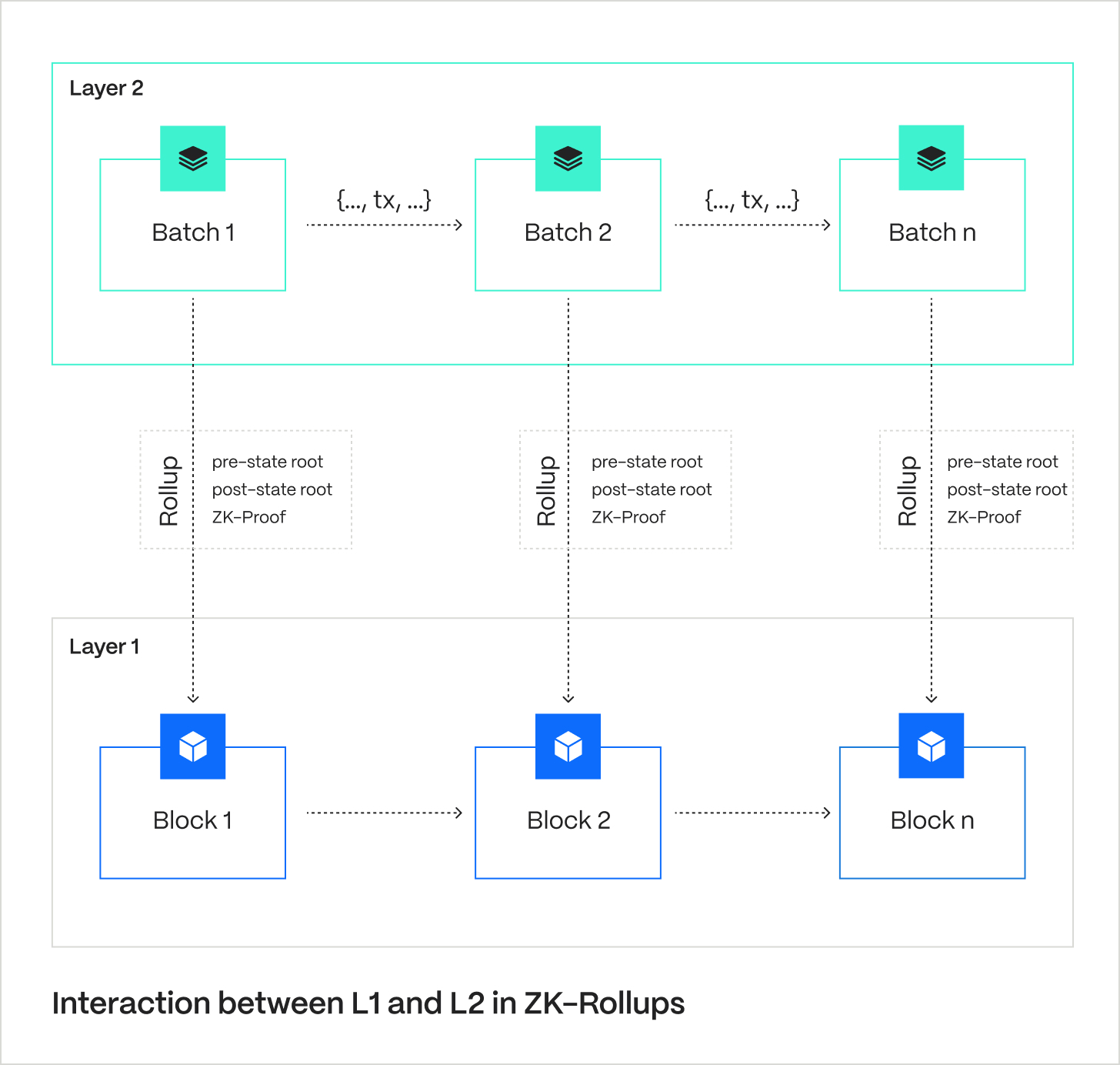
Zero-knowledge rollups have emerged as the dominant Layer 2 scaling mechanism for Ethereum in 2026, fundamentally altering the network's throughput capabilities. Unlike optimistic rollups, which rely on a seven-day challenge period to detect fraud, ZK rollups utilize cryptographic proofs to validate transactions instantly. This shift from verification by delay to verification by proof allows for immediate finality, a critical requirement for high-stakes financial applications and institutional liquidity.
A ZK rollup operates by batching thousands of transactions offchain and generating a single validity proof that is settled on the Ethereum mainnet. This proof acts as a cryptographic guarantee that all included transactions are valid, allowing the base layer to trust the result without re-executing the work. This architecture significantly reduces gas costs while maintaining the security guarantees of Ethereum's base layer.
The transition to zero-knowledge proofs addresses the latency and capital efficiency issues that plagued earlier scaling solutions. By eliminating the need for users to wait for challenge periods, ZK rollups provide the speed necessary for complex financial instruments. This efficiency is driving adoption among the primary networks discussed in this analysis: Starknet, zkSync, and Linea.
The market context for these protocols is anchored by Ethereum's base layer performance. As liquidity migrates to L2s, the underlying demand for ETH as the settlement asset remains robust. Understanding the technical differences between Starknet, zkSync, and Linea requires examining how each network implements these zero-knowledge proofs to balance security, speed, and developer experience.
Top ZK-Rollup Projects in 2026
The ZK-rollup landscape has consolidated around three primary contenders: Starknet, zkSync, and Linea. Each network employs a distinct proof system and targets different segments of the Ethereum ecosystem, creating a competitive triad for developers and capital.
Starknet relies on STARKs, a post-quantum proof system that scales horizontally through recursive proof aggregation. This architecture allows for high throughput but requires developers to write in Cairo, a purpose-built programming language. The trade-off is a steeper learning curve for users accustomed to standard Solidity environments.
zkSync Era utilizes PLONK proofs and maintains full EVM equivalence. This approach prioritizes compatibility, allowing developers to port existing Ethereum smart contracts with minimal modification. While this lowers the barrier to entry, the proof generation process is computationally intensive compared to STARK-based systems.
Linea, developed by ConsenSys, also targets EVM compatibility but focuses heavily on institutional adoption and privacy-preserving applications. Its infrastructure is designed to integrate seamlessly with existing financial workflows, leveraging the ConsenSys ecosystem for enterprise-grade support.
| Project | Proof System | EVM Compatible | Dev Language |
|---|---|---|---|
| Starknet | STARK | No | Cairo |
| zkSync Era | PLONK | Yes | Solidity |
| Linea | PLONK | Yes | Solidity |
The choice between these networks often hinges on the developer's technical stack versus the need for immediate ecosystem liquidity. Starknet offers superior scalability for high-frequency applications, while zkSync and Linea provide easier migration paths for existing Ethereum projects.
Starknet vs zkSync vs Linea
Starknet, zkSync, and Linea represent the three dominant architectures in the 2026 ZK-rollup landscape. Each chain prioritizes a different balance between developer accessibility, transaction throughput, and cryptographic security. Understanding these tradeoffs is essential for capital allocation and application development.
Starknet: StarkEx Legacy and STARKs
Starknet leverages STARK (Scalable Transparent ARguments of Knowledge) proofs, offering post-quantum security and transparency without a trusted setup. Its architecture, inherited from StarkEx, supports high throughput for complex state transitions, making it ideal for decentralized exchanges and high-frequency trading applications. The primary tradeoff is a steeper learning curve; developers must adopt Cairo, a specialized programming language, rather than the familiar Solidity ecosystem.
zkSync Era: EVM Equivalence and Adoption
zkSync Era prioritizes EVM equivalence, allowing Ethereum smart contracts to deploy with minimal modification. This approach significantly lowers the barrier to entry for developers migrating from L1. While it sacrifices some raw throughput compared to custom VMs, its compatibility ensures immediate access to the broader Ethereum tooling and liquidity ecosystem. It is the preferred choice for projects prioritizing rapid deployment and compatibility over maximum cryptographic efficiency.
Linea: ConsenSys Infrastructure and Scale
Backed by ConsenSys, Linea focuses on scale and integration within the Ethereum enterprise stack. It utilizes a custom ZK-VM that balances EVM compatibility with optimized proof generation. Linea’s strategy centers on becoming the default settlement layer for institutional and consumer applications requiring high transaction volumes. Its tradeoff lies in its relative maturity; while the infrastructure is robust, its ecosystem is still expanding compared to the entrenched networks of Starknet and zkSync.
Choosing a ZK-Rollup for Your Use Case
Selecting a ZK-rollup requires aligning technical constraints with your application’s specific demands. Starknet, zkSync, and Linea each solve the scaling problem differently, creating distinct trade-offs in developer experience, finality speed, and ecosystem maturity. There is no universal winner; the right choice depends on whether you prioritize EVM compatibility, raw throughput, or privacy.
If your team relies on Solidity and existing DeFi tooling, zkSync Era and Linea offer native EVM equivalence. This allows for direct deployment of smart contracts without rewriting code in Cairo (Starknet’s language) or adapting to non-standard opcodes. For teams prioritizing rapid deployment and access to established liquidity pools, this compatibility reduces friction and security risks associated with novel programming models.
Starknet generally offers higher theoretical throughput due to its STARK-based proof system and account abstraction model. It is better suited for applications requiring high-frequency trading or complex on-chain computations where gas costs must be minimized. zkSync and Linea, while fast, often optimize for compatibility over raw computational density, making them slightly less efficient for compute-heavy workloads but more consistent for standard transactional throughput.

For enterprise use cases or gaming applications requiring confidential state, Starknet’s architecture provides more flexible privacy primitives. Its native support for zero-knowledge proofs allows for selective disclosure of transaction data without exposing full chain state. Linea and zkSync are primarily focused on public scalability and do not currently offer built-in privacy features, making them less suitable for applications where data confidentiality is a core requirement.
| Platform | Language | Finality | Best For |
|---|---|---|---|
| Starknet | Cairo | ~20 mins | High-throughput, Privacy |
| zkSync Era | Solidity | ~20 mins | EVM DeFi, NFTs |
| Linea | Solidity | ~20 mins | General Purpose, EVM |
No comments yet. Be the first to share your thoughts!