

Ethereum's scaling landscape is shifting as native rollups emerge to challenge the established ZK rollups. With EIP-8079 introducing an EXECUTE precompile that exposes Ethereum's state transition function directly to smart contracts, developers now have a prototype for rollups that lean heavily on Layer 1 security. This move addresses long-standing pain points in ZK rollup governance differences and Ethereum STF verification methods, promising a more unified ecosystem without the fragmentation of independent L2s.
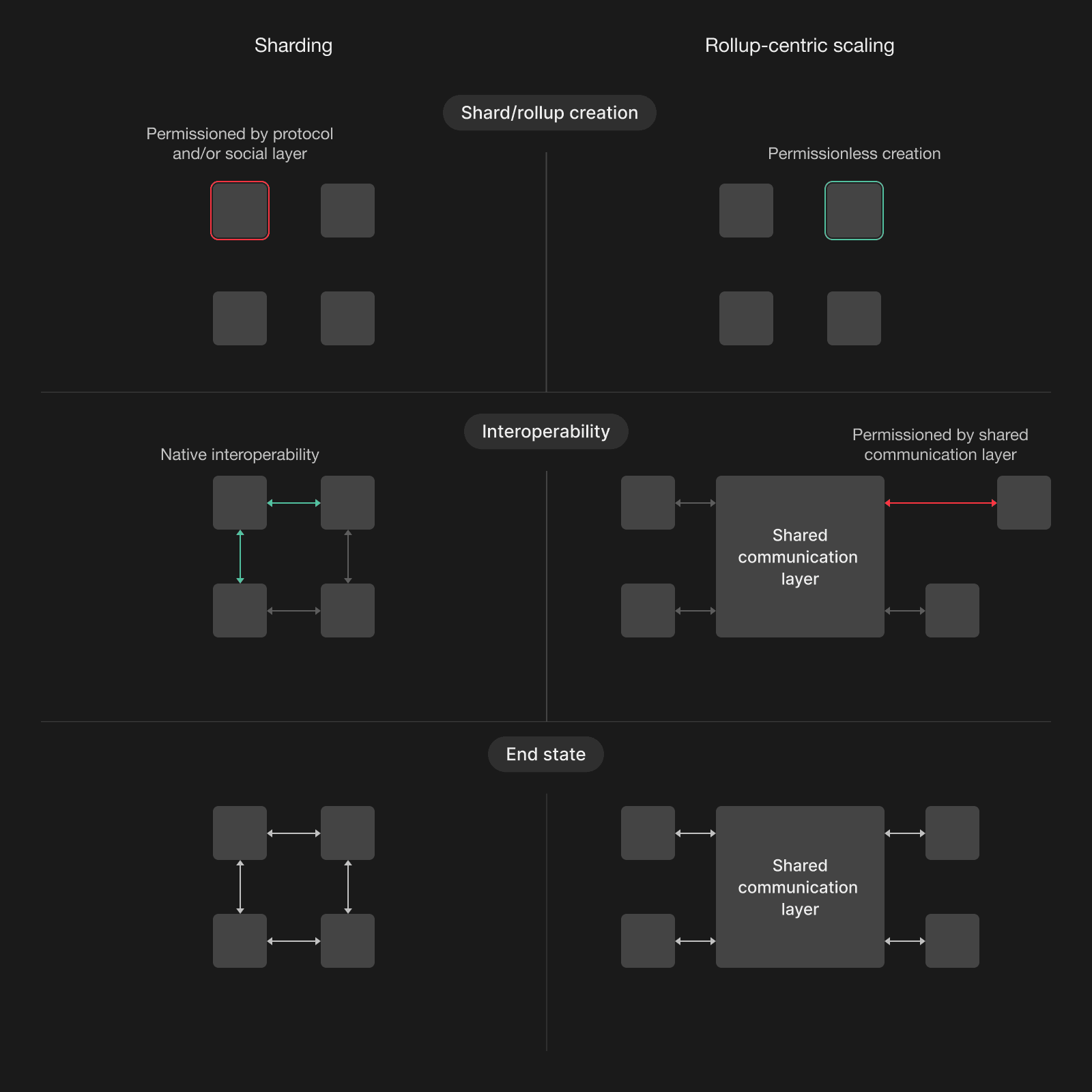
Current ZK rollups execute transactions off-chain, bundle them, and post validity proofs to Ethereum. They deliver privacy and efficiency but at the cost of self-contained governance. Each project deploys its own contracts, bridges, and validator sets, creating silos where users juggle multiple interfaces for assets and interactions. This setup, while innovative, introduces risks: security councils often hold emergency keys, and cross-chain bridges become attack vectors.
Governance Boundaries of ZK Rollups
ZK rollups prioritize sovereignty. Operators run off-chain networks, generate zero-knowledge proofs for state transitions, and settle on Ethereum. Governance falls to decentralized autonomous organizations or multisig committees, which manage upgrades, sequencer rotations, and dispute resolution. Scroll. io notes that this independence maximizes innovation speed but deviates from Ethereum's core security model, relying on external proof systems to mimic L1 execution.
Fragmentation hits users hardest. Assets lock into rollup-specific contracts, demanding separate deposits and withdrawals. Bridging between rollups adds latency and fees, eroding the seamless experience Ethereum envisions. From a risk perspective, this multiplies trust assumptions: each rollup's smart contracts, oracles, and councils must be vetted individually. In volatile markets, a single governance lapse can cascade, as seen in past L2 incidents.
Yet ZK rollups shine in privacy. Validity proofs ensure atomic settlement without revealing details, a boon for DeFi privacy layers. Their maturity, with projects like zkSync and Polygon zkEVM live, sets a high bar for newcomers.
Native Rollups: Tightening Governance with L1 Inheritance
Enter EIP-8079 native rollup, prototyped with Ethrex client. Here, rollups don't replicate Ethereum's execution; they invoke it via the EXECUTE precompile. L1 validators verify L2 states directly, slashing the need for bespoke proofs or councils. Ethereum Research highlights this as a path to full L1 security, eliminating attack vectors like centralized sequencers or governance vetoes.
Governance unifies under Ethereum's model. No fragmented contracts; native rollups embed within L1 primitives, streamlining asset management. Users interact via familiar Ethereum interfaces, deposits flow through shared mechanisms, and upgrades align with network consensus. This cohesion reduces complexity, a pragmatic win for risk-averse investors eyeing scalable dApps.
Challenges persist. Deviations from pure EVM could require zkEVM tweaks, and prototype scaling remains unproven. Still, native rollups position Ethereum as a monolith, where L2s enhance rather than diverge.
Ethereum Technical Analysis Chart
Analysis by Natalie Rhodes | Symbol: BINANCE:ETHUSDT | Interval: 1D | Drawings: 7
Technical Analysis Summary
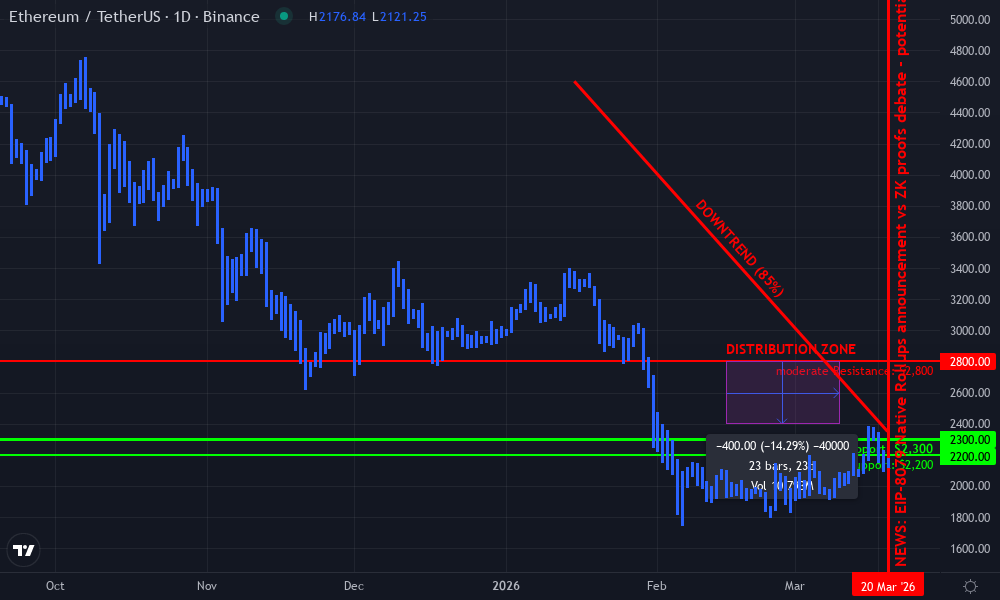
As Natalie Rhodes, start by drawing a primary downtrend line connecting the swing high at 2026-01-15 around 4600 to the recent low near 2026-03-20 at 2350, using the 'trend_line' tool to highlight the dominant bearish channel. Add horizontal lines at key support (2300, strong) and resistance (2800 moderate, 3500 weak) levels. Mark a date_price_range for the consolidation zone from 2026-02-15 to 2026-03-10 between 2400-2600. Use fib_retracement from the peak to recent low for potential retracement levels (e.g., 38.2% at ~3200). Place arrow_mark_down on the MACD bearish crossover around 2026-02-20, and a callout on high volume spikes during the March breakdown. Vertical line at 2026-03-20 for the Native Rollups news event. Add text notes for risk warnings: 'Security first - wait for confirmation above 2800.' Finally, rectangle around the potential accumulation base near 2300 support.
Risk Assessment: high
Analysis: Dominant downtrend, high volatility from scaling news, no clear reversal signals yet - low tolerance setup favors sidelines.
Natalie Rhodes's Recommendation: Stay out or scale tiny long at support with 1:2 RR max. Security first: await close above 2800 for longs.
Key Support & Resistance Levels
📈 Support Levels:
- $2,300 - Recent swing low with volume cluster, strong psychological base. strong
- $2,200 - Extension of downtrend, prior minor low. moderate
📉 Resistance Levels:
- $2,800 - Recent breakdown level, now overhead resistance. moderate
- $3,500 - February consolidation high, weaker on lower volume. weak
Trading Zones (low risk tolerance)
🎯 Entry Zones:
- $2,320 - Bounce from strong support at 2300 with volume confirmation and MACD divergence. low risk
- $2,700 - Break above resistance for trend reversal confirmation - conservative hybrid entry. medium risk
🚪 Exit Zones:
- $2,800 - First profit target at resistance. 💰 profit target
- $2,250 - Tight stop below support to limit downside. 🛡️ stop loss
- $3,500 - Secondary target if bullish breakout. 💰 profit target
Technical Indicators Analysis
📊 Volume Analysis:
Pattern: Increasing on downside breakdowns, especially late Feb to March, signaling distribution.
High volume confirms bearish moves, low on bounces - watch for reversal spike.
📈 MACD Analysis:
Signal: Bearish crossover in late Jan, histogram negative, no divergence yet.
Momentum aligned with price downtrend, potential bottom if bullish cross forms.
Applied TradingView Drawing Utilities
This chart analysis utilizes the following professional drawing tools:
Disclaimer: This technical analysis by Natalie Rhodes is for educational purposes only and should not be considered as financial advice. Trading involves risk, and you should always do your own research before making investment decisions. Past performance does not guarantee future results. The analysis reflects the author's personal methodology and risk tolerance (low).
| Feature | ZK Rollups | Native Rollups |
|---|---|---|
| Governance Model | Independent DAOs/Councils | L1 Ethereum Consensus |
| Asset Fragmentation | Rollup-specific Contracts | Unified L1 Primitives |
| Security Dependencies | Bridges and Proof Systems | EXECUTE Precompile |
| Risk Vectors | Multisig Keys, Sequencers | Validator Slashing |
Dissecting Ethereum STF Verification
At the core of native rollups vs ZK rollups lies state transition function verification. ZK rollups compress executions into succinct proofs, cryptographically attesting validity off-chain before L1 posting. This demands heavy computation; provers grind through circuits, often on GPUs, balancing speed against cost.
Native rollups flip the script. EIP-8079 lets contracts call Ethereum's STF natively, replaying L2 batches on L1. Validators execute deterministically, confirming transitions without ZK overhead. BlockEden. xyz demos show this inheriting Ethereum's battle-tested logic, sidestepping proof maintenance burdens.
While ZK rollups demand rigorous circuit design and proof generation, native rollups distribute verification across Ethereum's validators, leveraging their economic incentives for honesty. This shift minimizes centralization risks tied to prover networks, a pragmatic hedge against single points of failure. From my vantage as a risk specialist, ethereum stf verification zk methods introduce computational dependencies that could falter under high load, whereas native approaches align with Ethereum's proven slashing regime.
Risk Trade-offs in Verification and Governance
ZK rollups excel in throughput, processing thousands of transactions per second off-chain before proof submission. Their proofs are non-interactive and final, offering instant security absent fraud proof windows. But governance introduces friction: security councils wield override powers, tempting collusion or errors during crises. We've witnessed this in optimistic rollups; ZK variants aren't immune despite validity proofs.
Native rollups counter with L1 purity. No councils needed; disputes resolve through Ethereum's consensus. Yet execution replay on L1 spikes gas costs for large batches, potentially bottlenecking adoption. EIP-8079 mitigates via precompiles, but real-world tests loom. Scroll. io flags deviations from standard EVM as pitfalls, where zkEVM adaptations might reintroduce proof complexities, blurring native zk rollup ethereum ideals.
Comparison of STF Verification Methods: ZK Rollups vs Native Rollups
| Aspect | ZK Rollups | Native Rollups |
|---|---|---|
| Verification Method | Zero-knowledge proofs (ZK-SNARKs/STARKs) for off-chain state transitions | L1 replay via EXECUTE precompile (EIP-8079) exposing Ethereum STF |
| Execution Location | Off-chain by operators, proofs posted to L1 | On L1 by Ethereum validators (replay execution) |
| Computational Requirements | GPU-intensive proof computation | Gas-heavy but distributed across validators (CPU-focused) |
| Privacy Focus | High privacy (validity proofs hide details) | Transparent (full transaction replay on L1) |
| Trust Model | Cryptographically verified validity proofs | Trust-minimized, inherits full L1 consensus security |
| Resource Distribution | Operator-centralized proof generation | Validator-distributed execution |
Investors face clear choices. ZK rollups suit high-privacy DeFi, where fragmented governance trades off for customization. Native rollups appeal to those prioritizing capital efficiency and minimal trust, akin to restaking protocols that amplify L1 security. My framework: assess exposure by sequencing risks - ZK leans on operators and circuits; native on Ethereum's maturity.
Prototypes like Ethrex signal momentum. BlockEden demos replay L2 states seamlessly, hinting at rollups indistinguishable from L1 extensions. This convergence could consolidate liquidity, curbing the multichain sprawl that dilutes TVL and inflates bridging hacks.
Developer and Investor Implications
For builders, eip-8079 native rollup lowers barriers. No custom provers or EVM forks; deploy with Ethereum primitives. This accelerates iteration, fostering dApps that scale without sovereignty overhead. Risk drops as upgrades piggyback L1 forks, audited by the network's eyes.
Portfolios benefit from unification. Unified assets mean less bridging volatility, tighter correlations to ETH. In downturns, native rollups weather storms via L1 resilience, while ZK silos risk isolated sequencer downtimes. Diversify thoughtfully: allocate to mature ZK for proven yields, tilt native for long-term bets on Ethereum maximalism.
Challenges remain stubborn. Native verification scales poorly without sharding synergies, and ZK hardware advances could outpace. Hybrids might emerge, blending EXECUTE calls with succinct proofs for optimal gas-privacy balance.
Ethereum's path favors integration. Native rollups don't supplant ZK; they refine the stack, channeling innovations into a fortified core. Security-first builders will watch prototypes closely, as governance cohesion and STF fidelity redefine scaling risks. Growth, as always, trails disciplined risk navigation.




No comments yet. Be the first to share your thoughts!