What zero knowledge proofs verify
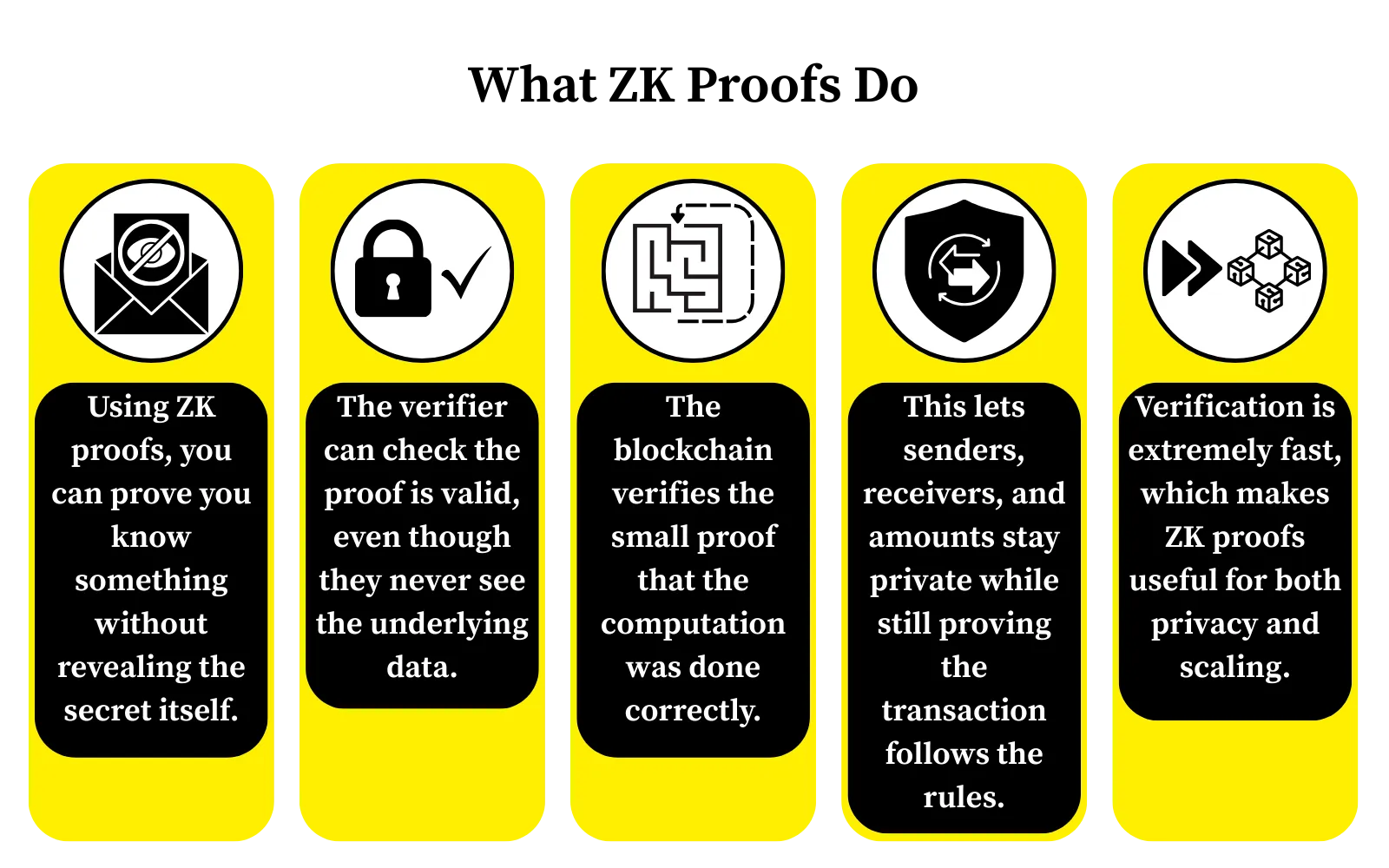
A zero knowledge proof (ZKP) is a cryptographic protocol that allows a prover to convince a verifier that a specific statement is true without revealing any information beyond the validity of that statement itself. This mechanism serves as a foundational tool for privacy-enhancing cryptography (PEC), enabling the verification of mathematical statements while keeping underlying data confidential. As regulatory frameworks for artificial intelligence increasingly demand transparency without compromising user privacy, ZKPs provide a technical method to validate compliance and data integrity simultaneously.
The protocol relies on three established cryptographic properties: completeness, soundness, and zero-knowledge. Completeness ensures that if the statement is true and both parties follow the protocol, the verifier will be convinced. Soundness guarantees that a cheating prover cannot convince the verifier of a false statement. The zero-knowledge property ensures that the verifier learns nothing other than the fact that the statement is true. These properties are rigorously defined by standards bodies such as NIST and the ZKProof community, ensuring that implementations remain consistent and secure across different regulatory jurisdictions.
In practical terms, this means an AI system can prove it has processed data according to legal requirements without exposing the raw data or the specific algorithmic decisions involved. For example, a user can prove they meet an age requirement without revealing their exact birth date or identity. This capability is critical for AI regulation, where the need to audit model behavior must be balanced against the imperative to protect personal data under laws like the GDPR. By verifying outcomes rather than exposing inputs, ZKPs create a verifiable audit trail that satisfies regulatory scrutiny while preserving privacy.
ZKPs meet AI compliance requirements
Regulatory frameworks such as the EU AI Act and GDPR mandate strict data protection while requiring demonstrable compliance. Traditional auditing methods often force organizations to expose raw user data to verify adherence, creating a direct conflict with privacy obligations. Zero-knowledge proofs (ZKPs) resolve this tension by allowing AI systems to generate cryptographic evidence of compliance without revealing the underlying data. As defined by the NIST Privacy-Enhancing Cryptography (PEC) initiative, ZKPs enable the proof of mathematical truthfulness while keeping the input private [src-serp-4].
For high-stakes AI applications where data sensitivity is paramount, this approach allows models to prove they have not been trained on restricted personal data or that their decisions do not violate specific demographic thresholds, all without disclosing the training set or individual user records. The ZKProof standards initiative provides the cryptographic rigor needed to ensure these proofs are valid and resistant to tampering, establishing a trusted foundation for regulatory verification [src-serp-8].
To understand the operational difference between legacy auditing and ZK-based verification, consider the following comparison:
| Feature | Traditional Auditing | ZK-Based Auditing |
|---|---|---|
| Data Exposure | Full dataset access required | No raw data exposed |
| Privacy Risk | High (data leakage potential) | Minimal (proof only) |
| Verification Speed | Slow (manual review) | Fast (automated validation) |
| Regulatory Acceptance | Standard but privacy-conflicting | Emerging (privacy-preserving) |
The shift toward ZKPs represents a fundamental change in how compliance is demonstrated. Instead of trusting auditors with sensitive information, organizations can provide mathematically verifiable proofs that satisfy regulatory requirements. This approach aligns with the principle of data minimization, a core tenet of modern privacy laws, by ensuring that only the necessary proof is shared. As AI regulation tightens in 2026, ZKPs will likely become the standard for proving compliance in sensitive domains such as healthcare, finance, and identity verification.
Technical requirements for implementation
Implementing zero-knowledge proofs requires balancing computational overhead with security guarantees. The simplest way to evaluate options is to define must-have criteria first, then compare each option against those criteria before weighing nice-to-have features. A practical choice should survive normal use, maintenance, timing, and budget constraints. If a recommendation only works in an ideal situation, that limitation must be called out plainly with a fallback path.
Real-world verification examples
Zero-knowledge proofs are moving from theoretical cryptography to practical deployment in identity protection and data verification. Regulators and financial institutions are increasingly adopting these protocols to satisfy compliance requirements without exposing sensitive underlying data. This approach allows for the verification of facts—such as age, creditworthiness, or transaction validity—while maintaining strict privacy boundaries.
Identity and Age Verification
One of the most immediate applications is digital identity verification. Organizations can issue verifiable credentials that allow users to prove specific attributes without revealing their full identity. For example, an individual can demonstrate they are over 18 or possess a valid government-issued passport without disclosing their name, date of birth, or country of origin. This is essential for regulated industries like finance and healthcare, where Know Your Customer (KYC) and Anti-Money Laundering (AML) laws require verification but also mandate data minimization.
Financial Compliance and Transaction Privacy
In the financial sector, zero-knowledge proofs enable institutions to prove compliance with regulatory thresholds without leaking customer transaction histories. A bank might use a ZK protocol to demonstrate that a series of transactions do not exceed a certain risk threshold or that a user’s assets meet minimum capital requirements. This ensures that auditors and regulators can verify the integrity of financial activities while protecting the privacy of individual account holders. Such systems are foundational for privacy-preserving AI regulation, where data provenance must be verified without exposing the raw data itself.
Tracking Adoption and Market Interest
The growing institutional interest in zero-knowledge technology is reflected in both patent filings and market activity. The following chart illustrates the performance of a relevant privacy-focused asset, serving as a proxy for market sentiment and adoption momentum in the broader zero-knowledge ecosystem.
No comments yet. Be the first to share your thoughts!