
The state of zero-knowledge proofs in 2026
Zero-knowledge proofs (ZKPs) have transitioned from experimental cryptography to foundational infrastructure. In 2026, the technology is no longer a theoretical curiosity but a critical component of scalable, private financial systems. The shift has been driven by the maturation of ZK-rollups and the integration of ZK-circuits into major blockchain networks, allowing for high-throughput transactions that maintain cryptographic privacy without sacrificing security.
The industry is now anchored by rigorous standardization efforts. The ZKProof initiative, an open-industry academic body, continues to establish the protocols that ensure interoperability and trust. Their work in 2026 focuses on mainstreaming ZKP cryptography, creating a unified language for developers and auditors. This standardization is essential for institutional adoption, as it reduces the risk of implementation errors and ensures that proofs generated on one platform can be verified on another. For a deeper understanding of the underlying mechanics, ethereum.org provides a clear overview of how provers and verifiers interact.
Market data reflects this structural shift. As ZK-rollups capture a significant share of Layer 2 activity, the performance and reliability of these networks are under constant scrutiny. The following chart illustrates the recent performance trends of key ecosystem tokens, highlighting the correlation between technological upgrades and market confidence.
This integration is not limited to Ethereum. Other networks, such as the XRP Ledger, are beginning to adopt ZKPs to enable private banking transactions, demonstrating the technology's versatility across different consensus mechanisms. As the infrastructure solidifies, the focus is shifting from basic proof generation to complex, application-specific circuits that can handle real-world financial logic with minimal latency.
Comparing ZK-Rollup Architectures
ZK-rollups are not a monolith. They diverge sharply on the cryptographic primitives they use to compress transactions, which dictates their security assumptions, developer experience, and throughput. Understanding these architectural differences is critical for assessing risk and scalability potential in the 2026 market.
The two dominant proof systems are SNARKs (Succinct Non-Interactive Arguments of Knowledge) and STARKs (Scalable Transparent Arguments of Knowledge). SNARKs offer smaller proof sizes and faster verification, making them ideal for EVM-equivalent chains that prioritize compatibility with existing smart contracts. However, they often rely on trusted setups, which introduces a potential, albeit small, security risk. STARKs, by contrast, are post-quantum secure and do not require trusted setups, but they generate larger proofs and require more computational resources to verify.
This trade-off creates distinct niches for leading implementations. StarkNet prioritizes STARKs for maximum long-term security and scalability, appealing to projects with high-throughput needs that can adapt to a non-EVM environment. zkSync focuses on SNARKs to maintain strict EVM equivalence, allowing developers to deploy Solidity contracts with minimal friction. Scroll also leverages SNARKs to achieve EVM equivalence while optimizing for lower gas costs.
The table below outlines the technical distinctions between these major architectures.
| Project | Proof System | EVM Compatible | Security Model | Primary Use Case |
|---|---|---|---|---|
| StarkNet | STARK | No (Cairo VM) | Post-Quantum Secure | High-throughput DeFi |
| zkSync | SNARK (Plonk) | Yes (EVM+) | Trusted Setup | General Smart Contracts |
| Scroll | SNARK (Plonk) | Yes (Full EVM) | Trusted Setup | Ethereum Layer 2 |
| Polygon zkEVM | SNARK (Plonk) | Yes (EVM) | Trusted Setup | Enterprise DApps |
The choice between these architectures often hinges on the developer's need for compatibility versus the project's demand for post-quantum resilience. For most current applications, EVM compatibility remains the primary driver for adoption, favoring SNARK-based solutions. However, as quantum computing advances, the transparent security of STARKs may become a decisive factor for institutional capital.
Privacy trends in institutional finance
The narrative around zero-knowledge proofs (ZKPs) in banking has shifted from theoretical possibility to urgent infrastructure necessity. For years, institutions faced a binary choice: expose sensitive transaction data to satisfy regulators or sacrifice the efficiency of digital assets. ZKPs dismantle this constraint, allowing banks to prove compliance without revealing the underlying trade details. This capability is the primary driver for the current wave of institutional adoption, moving privacy from a consumer-facing DeFi novelty to a core banking utility.
The transition is evident in recent protocol developments. The XRP Ledger’s integration of ZKP capabilities marks a significant milestone, enabling banks to transact privately for the first time at scale. Similarly, research into Bitcoin-based proof-of-reserve schemes demonstrates how ZKPs can verify solvency thresholds without exposing individual client balances. These are not incremental improvements; they are foundational shifts in how financial data is audited and shared.
However, the "opportunity vs. reality" gap remains wide. While the technology works, integrating it into legacy core banking systems requires substantial engineering effort. Institutions are not just adopting a new protocol; they are rewriting their compliance infrastructure. The winners in 2026 will be those who treat ZKP integration as a core operational upgrade rather than a peripheral experiment.
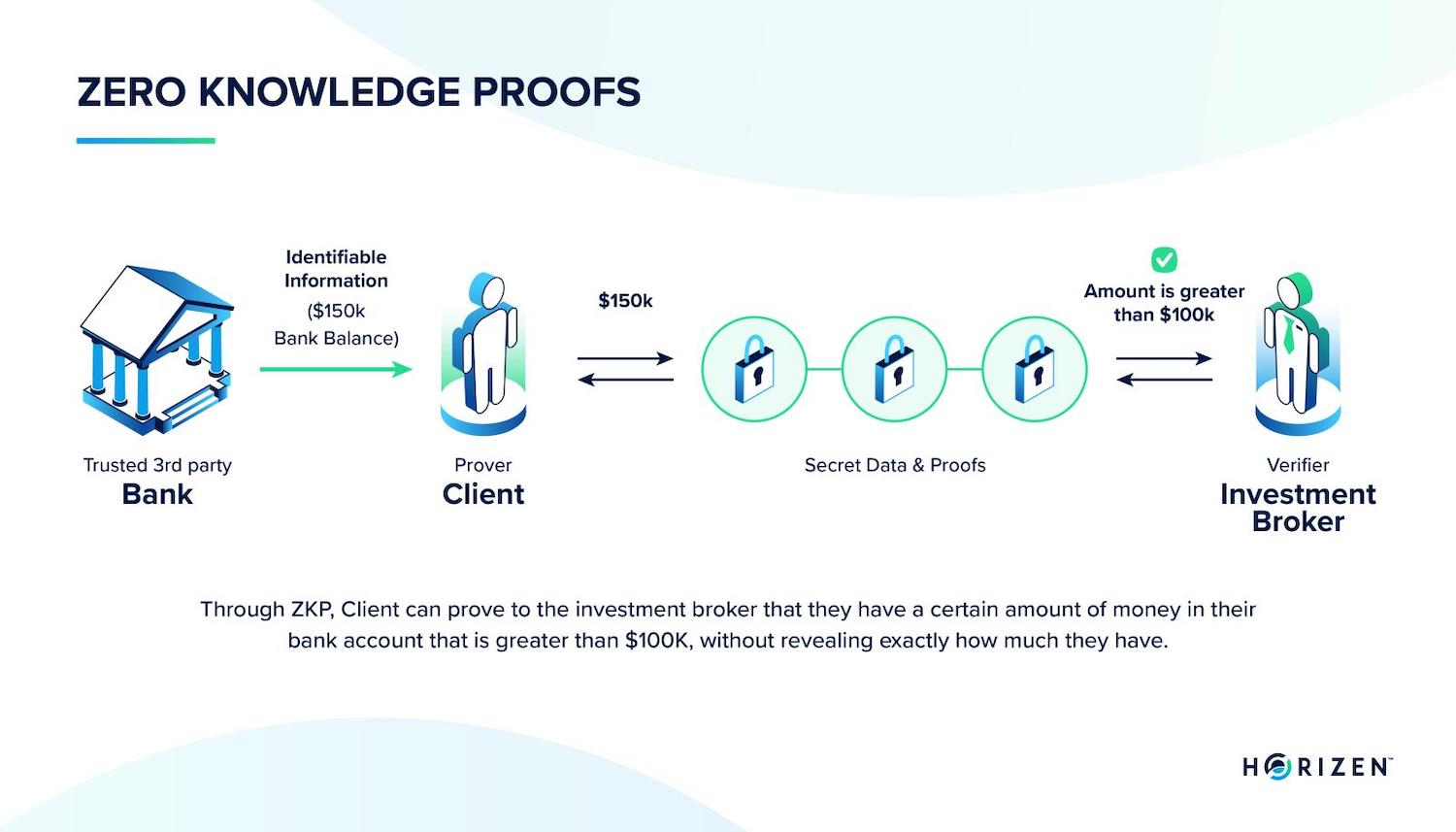
The regulatory landscape is beginning to catch up. Bodies like ZKProof are working to standardize verification protocols, ensuring that a privacy proof generated by one bank is verifiable by any regulator. Without these standards, institutional adoption will remain fragmented. The goal is a universal language of trust, where privacy is a default setting, not an opt-in feature.
Bitcoin and XRP Ledger Integrations
While Ethereum dominates the zero-knowledge narrative, the technology is rapidly penetrating non-EVM chains. Bitcoin and XRP are adopting ZKPs to solve specific institutional friction points: proof-of-reserve verification and private banking transactions, respectively. This expansion signals a maturation of the technology beyond simple scalability into core financial infrastructure.
Bitcoin: Proof-of-Reserve Verification
Bitcoin’s static nature has historically resisted complex cryptographic additions, but ZKPs offer a way to verify solvency without exposing the entire ledger. Researchers are developing schemes that allow custodians to prove they hold sufficient UTXOs (Unspent Transaction Outputs) to cover liabilities. These proofs enable users to verify ownership of specific amounts without revealing the full transaction history or the identity of other account holders.
This approach transforms Bitcoin from a transparent-but-anonymous chain into a verifiable financial asset for regulated entities. By using non-interactive ZKPs, exchanges can publish a single proof that anyone can verify against the Bitcoin blockchain, ensuring that the exchange remains solvent without compromising user privacy or exposing the exchange's operational details.
XRP Ledger: Private Banking Transactions
The XRP Ledger has integrated ZKPs to facilitate private transactions for institutional banking. Unlike Bitcoin’s transparent ledger, XRP’s implementation allows banks to conduct transactions without broadcasting the amount or counterparty to the public network. This is critical for traditional finance institutions that must comply with confidentiality requirements while still leveraging the speed and finality of the XRP Ledger.
This integration marks a significant shift for the XRP ecosystem, moving it from a speculative asset to a functional banking rail. By embedding ZKPs directly into the ledger, XRP enables cross-border settlements that are both fast and compliant with strict financial privacy standards, addressing a major barrier to institutional adoption.
No comments yet. Be the first to share your thoughts!