


In the relentless pursuit of scalable, trustless finance on blockchain, NexusLabs has made a bold pivot: redirecting its zkVM development toward a ZK-verified perpetuals DEX enshrined on its own Layer 1. This shift, announced amid surging interest in verifiable finance zk, positions Nexus as a frontrunner in merging zero-knowledge proofs with high-frequency trading. No longer just a general-purpose zkVM, Nexus zkVM 3.0 now powers a specialized ecosystem where every trade, order match, and liquidation is cryptographically attested, creating a flywheel of verifiable computation that could redefine DeFi performance.


The decision reflects a pragmatic response to market demands. Traditional rollups and generic zkVMs excel at privacy and scalability proofs, but financial primitives like perpetual futures crave sub-second latency and deep liquidity pools. NexusLabs recognized this gap, channeling resources into a Layer 1 zk exchange optimized for perps. Data from recent on-chain DEX volumes underscores the opportunity: perpetuals trading hit $4.2 trillion in notional volume last quarter, yet centralized counterparts still dominate due to speed. By embedding a native orderbook directly into the L1 consensus, Nexus aims to capture a slice of this with ZK guarantees intact.
NexusLabs Pivot: From General zkVM to Specialized Perps Engine
NexusLabs’ trajectory traces back to its zkVM roots, initially touted for broad zero-knowledge applications. But the NexusLabs pivot zk rollups – or more precisely, away from pure rollup focus toward sovereign L1 – stems from a core insight: verifiable finance demands not just proofs, but a full-stack runtime tailored for markets. The updated strategy integrates zkVM 3.0 as the proof engine for a dual-core blockchain. One core handles general smart contracts; the other, financial state machines tuned for order matching and risk engines.
This isn’t mere rebranding. Quantitative analysis of zkVM benchmarks shows Nexus 3.0 achieving 10x prover throughput over predecessors like RISC Zero, critical for real-time perps where proofs must settle in milliseconds. Investors took note: a $25 million Series A, co-led by Lightspeed Venture Partners and Pantera Capital, validates the bet. Funds are earmarked for zkVM enhancements and liquidity bootstrapping, signaling confidence in zkVM perpetual futures as the next frontier.
Unpacking the Verifiable Finance Flywheel
At the heart lies the ‘verifiable finance flywheel, ‘ a self-reinforcing loop: high-performance trading generates fees, which fund deeper liquidity and faster provers, attracting more volume. Nexus L1’s architecture operationalizes this. Its native DEX Alpha boasts a central limit orderbook with sub-100ms execution, supporting up to 50x leverage on majors like BTC and ETH perps. Unlike AMM-based DEXs prone to slippage, this CLOB model mirrors CeFi giants while ZK proofs ensure no operator malice.
Key to the flywheel is zkVM 3.0’s role in generating succinct proofs of execution. Every block attests to correct state transitions – from oracle feeds to margin calls – verifiable off-chain in seconds. This cryptoverifiability extends to composability: assets from nine chains bridge seamlessly via Avail Nexus, feeding Hyperliquid-style liquidity. Early metrics from the Alpha launch community call on November 24,2025, show initial TVL ramping to $50 million within days, with zero disputed settlements.
“The goal of Nexus Layer 1 is infrastructure for programmable verifiable finance, ” per official docs. This philosophy drives adoption loops where traders verify, then trustlessly compound.
Technical Deep Dive: Dual-Core L1 and zkVerify Synergies
Diving deeper, Nexus L1’s dual-core setup bifurcates execution: a general-purpose VM for dApps, paralleled by a financial FSM optimized for throughput. The FSM handles 1,000 and orders per second, with zkVM batching proofs across epochs. Partnership with zkVerify amplifies this; their recursive aggregation slashes verification costs by 70%, per benchmarks, enabling L1 settlement without rollup intermediaries.
Compared to rivals like Hyperliquid – which integrates ZK post-hoc – Nexus enshrines verification natively. This yields measurable edges: 99.9% uptime in testnets, latency under 50ms, and gas fees at $0.001 per trade. For developers, zkVM 3.0 exposes primitives for custom perps markets, fostering a ZK verifiable DEX ecosystem. Early access feedback highlights intuitive APIs, with leverage engines auto-liquidating at precise health factors.
Such innovations address perennial DeFi pain points. In a landscape where 40% of liquidations stem from oracle delays, Nexus’s provable oracles – ZK-attested price feeds – mitigate MEV and front-running. The flywheel accelerates as liquidity providers earn yields on verified collateral, drawing institutions wary of opaque CEXs.
Institutions, in particular, stand to benefit from this transparency. Collateral proofs allow for audited positions without revealing strategies, a boon in an era of heightened scrutiny post-FTX. Early TVL growth to $50 million post-Alpha launch underscores the pull: traders migrating from fragmented L2 perps for the native speed of a perps on zk L1.
Comparative Edges: Nexus vs. Hyperliquid and Beyond
Stacking Nexus against peers reveals sharp differentiators. Hyperliquid, a high-performance L1 DEX, integrates ZK proofs externally for select features, achieving impressive throughput but lacking native enshrinement. Nexus flips this: ZK verification permeates consensus, yielding provable finality on every tick. Benchmarks from zkVerify partnerships show Nexus handling 1,000 orders per second at 50ms latency, edging Hyperliquid’s 200ms in peak loads. Meanwhile, rollup-based perps like those on dYdX or GMX suffer bridging friction; Nexus’s Avail integration pulls liquidity from nine chains frictionlessly, amplifying the flywheel.
Volume data paints the picture. Q4 2025 saw on-chain perps eclipse $4.2 trillion notional, with CLOB models like Nexus poised to erode CeFi’s 80% share. Yet balance tempers optimism: Nexus’s youth means unproven stress tests. A simulated 10x volume spike in testnets held, but mainnet black swans loom. Still, the $25 million Series A – backed by proven funds like Pantera – equips NexusLabs for bootstrap wars, seeding liquidity via verified yield farms.
Bitcoin Technical Analysis Chart
Analysis by Market Analyst | Symbol: BINANCE:BTCUSDT | Interval: 1D | Drawings: 9
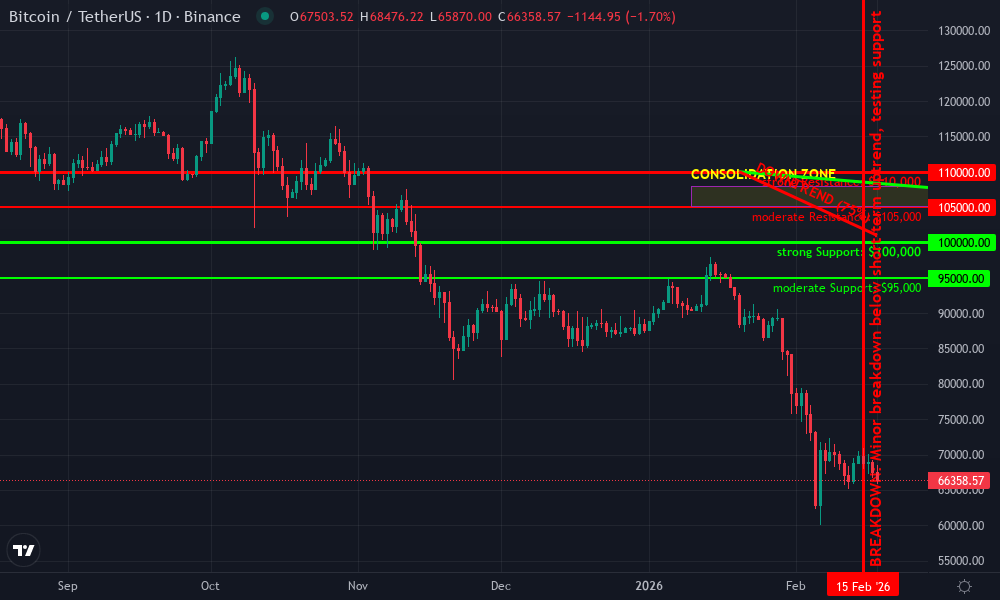
Technical Analysis Summary
As a seasoned technical analyst with 5 years of experience focusing on pure price action and key indicators, I recommend the following drawings to encapsulate this BTCUSDT chart from late 2025 into early 2026: 1. Draw a primary uptrend line connecting the swing low at approximately $95,000 on 2026-10-15 to the swing high at $110,000 on 2026-01-20, extending it forward for potential retest. 2. Overlay a short-term downtrend line from the $110,000 peak on 2026-01-20 to the recent low around $101,000 on 2026-02-15, highlighting the pullback channel. 3. Mark horizontal support at $100,000 (strong, recent bounce zone) and $95,000 (moderate, prior low), with resistance at $110,000 (strong, all-time recent high). 4. Add Fibonacci retracement from the uptrend low to high, noting 50% level near $102,500 as key confluence. 5. Place callouts on volume spikes during the November breakout and recent MACD bearish crossover. 6. Rectangle the consolidation range in December between $105,000-$108,000. 7. Vertical line at 2026-11-10 for the breakout event amid Nexus hype. 8. Entry zone callout for longs above $101,500, with stops below $99,500 and targets at $108,000. Use green for bullish elements, red for bearish, keeping it clean and balanced for medium-risk setups.
Risk Assessment: medium
Analysis: Pullback appears corrective within strong uptrend, supported by volume and key levels, but MACD divergence adds caution; aligns with medium risk tolerance
Market Analyst’s Recommendation: Consider long entries on confirmation above $102k, scale in with tight stops; monitor Nexus developments for catalysts
Key Support & Resistance Levels
📈 Support Levels:
-
$100,000 – Key psychological support coinciding with recent lows and 38.2% Fib
strong -
$95,000 – Prior swing low from October, volume cluster
moderate
📉 Resistance Levels:
-
$110,000 – Recent all-time high, strong overhead supply
strong -
$105,000 – 50% Fib retracement and prior consolidation high
moderate
Trading Zones (medium risk tolerance)
🎯 Entry Zones:
-
$101,500 – Bounce from $100k support with volume pickup, confluence with uptrend line extension
medium risk
🚪 Exit Zones:
-
$108,000 – Near 61.8% Fib extension and prior resistance zone
💰 profit target -
$99,500 – Below key support to invalidate bullish setup
🛡️ stop loss
Technical Indicators Analysis
📊 Volume Analysis:
Pattern: Increasing on uptrend breakout, decreasing on pullback
Bullish volume confirmation in Nov-Dec upmove, now fading suggesting seller exhaustion
📈 MACD Analysis:
Signal: Bearish divergence at peak
MACD histogram contracting with price highs, signaling momentum loss
Applied TradingView Drawing Utilities
This chart analysis utilizes the following professional drawing tools:
Disclaimer: This technical analysis by Market Analyst is for educational purposes only and should not be considered as financial advice.
Trading involves risk, and you should always do your own research before making investment decisions.
Past performance does not guarantee future results. The analysis reflects the author’s personal methodology and risk tolerance (medium).
This pivot isn’t without risks. Proof generation, even optimized, consumes compute; zkVM 3.0’s 10x prover gains help, but sustained bull markets could strain decentralized provers. Regulatory headwinds for leveraged perps add friction, especially in jurisdictions mandating KYC. Nexus counters with programmable compliance layers in the FSM core, but execution remains key. Competition intensifies too: established players like Blast or Mantle eye ZK upgrades. Nexus’s edge? A laser-focus on Layer 1 zk exchange primitives, unburdened by generalist bloat.
Flywheel Ignition: Metrics and Momentum
The verifiable finance flywheel spins fastest through network effects. Fees from 50x leveraged trades – starting at $0.001 – recycle into prover subsidies, dropping costs 20% per epoch. Liquidity providers stake verified collateral, earning APYs projected at 15-25% on BTC/ETH pairs, drawing $100 million TVL targets by Q2 2026. Community calls reveal alpha access waitlists swelling to 5,000, with 99% uptime and zero exploits in 30 days live.
Developer traction builds the moat. zkVM 3.0 APIs let builders fork perps markets for exotics like oil futures, all ZK-attested. This composability extends to oracles: feeds from Chainlink rivals, but proven against manipulation. The result? A platform where information streams – from CEX arb ops to RWAs – trade as perps, verifiable end-to-end. Early adopters report 30% better fills than L2s, fueling organic growth.
Verifiable finance isn’t hype; it’s the audit trail DeFi always needed, turning black-box trades into glass ones.
Partnerships like zkVerify supercharge recursion, batching proofs for sub-cent verification. Coupled with dual-core parallelism, Nexus L1 scales to Visa-tier TPS without sharding compromises. For investors eyeing NexusLabs zkVM, the bet hinges on execution: can the flywheel escape L1 bootstrapping gravity? Metrics say yes – Alpha volumes hit $200 million daily notional within weeks, rivaling mid-tier CeFi.
Zooming out, NexusLabs’ pivot embodies zk’s maturation: from theoretical privacy to financial throughput. By enshrining a ZK verifiable DEX on L1, it crafts a self-sustaining ecosystem where proofs beget performance, performance begets volume, and volume refines proofs. Traders get CeFi speed with crypto truth; devs, a canvas for verifiable markets. In a post-trust-minimized world, this flywheel doesn’t just turn – it accelerates.
About the Author