

With Bitcoin firmly established at $109,392.29, up $98.53 or 0.0900% over the past 24 hours, investors seek ways to generate yield on their holdings without compromising security or decentralization. Enter GOATRollup, the pioneering Bitcoin-native ZK rollup that unlocks sustainable BTC yields through trustless infrastructure and decentralized sequencing. This innovation addresses Bitcoin’s core limitations in scalability and DeFi utility, paving the way for BTC-denominated financial activity directly on the network.

GOAT Network’s approach stands out in the crowded field of layer-2 solutions. Unlike wrapped BTC bridges prone to exploits, GOATRollup inherits Bitcoin’s native security via BitVM2 and zkMIPS technology. Launched in May 2025, its BTC Yield Dashboard offers products like GOAT Safebox, BTCB/DOGEB Vault, Sequencer PoS Staking, and BTC Lending, enabling holders to earn real Bitcoin yield without centralized custody.
Decentralized Sequencing: Powering Bitcoin ZK Rollups Without Central Points of Failure
Traditional rollups often rely on centralized sequencers, creating vulnerabilities and single points of failure. GOATRollup flips this script with decentralized sequencing zk, where any node operator can participate in block sequencing. Participants capture transaction fees in BTC and mining rewards in $GOATED tokens, fostering alignment among stakeholders. This model, detailed in recent analyses, ensures censorship resistance and liveness from day one. Explore how this powers Bitcoin scaling.
In July 2025, the BitVM2 Beta Testnet launch demonstrated sub-three-second real-time proving across five provers, slashing challenge windows and enabling instant fund access. This milestone, combined with zkMIPS, positions GOATRollup as the first to deliver verifiable BTC yields zk rollups natively on Bitcoin.
At its core, GOATRollup leverages BitVM2 for fraud-proof security and zkMIPS, an in-house zero-knowledge virtual machine optimized for Bitcoin scripts. This stack supports high-throughput transactions settled on Bitcoin L1, with dispute resolution and exits handled trustlessly. The architecture avoids inflationary mechanics, relying instead on on-chain revenue from BTC gas fees, block production rewards, and MEV from sequencer-level ordering.
The economic flywheel is elegant: heightened network activity boosts fee generation, which recirculates as yields to stakers and users, drawing more liquidity and compounding growth. By September 2025, $GOATED launched on Binance Alpha, integrating multi-asset PoS consensus to return revenues in Bitcoin. This GOATRollup zk rollup model proves economically viable for long-term Bitcoin productivity.
Bitcoin (BTC) Price Prediction 2027-2032
Projections factoring in GOAT Network’s Bitcoin-native ZK Rollup advancements for sustainable BTC yields via decentralized sequencing
| Year | Minimum Price | Average Price | Maximum Price | YoY % Change (Avg) |
|---|---|---|---|---|
| 2027 | $90,000 | $160,000 | $280,000 | +45% |
| 2028 | $120,000 | $250,000 | $450,000 | +56% |
| 2029 | $180,000 | $350,000 | $600,000 | +40% |
| 2030 | $250,000 | $500,000 | $850,000 | +43% |
| 2031 | $350,000 | $700,000 | $1,200,000 | +40% |
| 2032 | $450,000 | $950,000 | $1,600,000 | +36% |
Price Prediction Summary
Bitcoin’s price is forecasted to experience robust growth from 2027 to 2032, propelled by GOAT Network’s innovations in ZK Rollups, BitVM2, and decentralized sequencers enabling real BTC yields. Starting from a 2026 baseline of ~$110,000, average prices could climb to nearly $1M by 2032 amid bull cycles, halvings, and enhanced Bitcoin DeFi utility, with wide ranges accounting for bearish dips and euphoric peaks.
Key Factors Affecting Bitcoin Price
- GOAT Network’s BTC Yield Dashboard and real-time ZK proving boosting on-chain activity and native yields
- Bitcoin halvings in 2028 and 2032 reducing supply issuance
- Growing institutional adoption and regulatory clarity for BTCFi
- Scalability via ZK Rollups and decentralized sequencers reducing fees and enhancing utility
- Macro trends, market cycles, and competition from other L2s influencing volatility
Disclaimer: Cryptocurrency price predictions are speculative and based on current market analysis.
Actual prices may vary significantly due to market volatility, regulatory changes, and other factors.
Always do your own research before making investment decisions.
Developers benefit from zkMIPS’s EVM compatibility, enabling seamless dApp porting for BTCFi applications. GitHub activity, with 46 repositories, underscores active progress toward mainnet. As Bitcoin hovers near $110,000 highs, GOATRollup’s innovations signal a shift toward scalable, yield-bearing infrastructure.
The BTC Yield Dashboard aggregates chain-level products tailored for diverse risk profiles. Conservative users opt for Safebox staking, while DeFi enthusiasts engage BTC Lending or Sequencer PoS. All yields accrue in native BTC, backed by protocol revenues rather than token emissions. This bridge-free design minimizes risks associated with cross-chain transfers, a persistent issue in BTCFi.
These mechanisms transform idle BTC into productive assets, with yields derived from sequencer fees, staking rewards, and lending pools. At Bitcoin’s current price of $109,392.29, even modest 2-5% annualized returns compound significantly over time, outpacing traditional savings without exposure to altcoin volatility.
The Economic Flywheel: Sustainable Revenue Without Inflation
GOATRollup’s design creates a self-reinforcing loop powered by real economic activity. BTC-denominated gas fees fund operations, while block producers earn $GOATED alongside BTC rewards. MEV from optimal transaction ordering further bolsters revenues, all funneled back as yields. This bitcoin native zk rollup avoids the dilution pitfalls of emission-based models, ensuring long-term viability. Analyses highlight how this flywheel scales with adoption, projecting revenue growth tied directly to transaction volume. Dive into the BitVM2 and zkMIPS integration.
From a risk management perspective, this revenue model merits attention. Historical data from similar L2s shows that sequencer decentralization reduces outage risks by 70-80%, per industry benchmarks. Investors should monitor testnet metrics like proving latency and sequencer participation rates, currently exceeding 50 nodes, as leading indicators of mainnet resilience.
Risks Assessed: Security, Liveness, and Economic Sustainability
While promising, no protocol is risk-free. Potential sequencer collusion poses theoretical threats, though BitVM2’s challenge-response slashes attack windows to seconds. Bridge-free architecture eliminates custody hacks, a flaw claiming over $2 billion in BTCFi exploits since 2023. My conservative stance favors allocations under 10% of BTC portfolios here, prioritizing yield data over hype. Track the BTC Yield Dashboard for transparent APYs, which have stabilized above 3% in testnet simulations.
Bitcoin Technical Analysis Chart
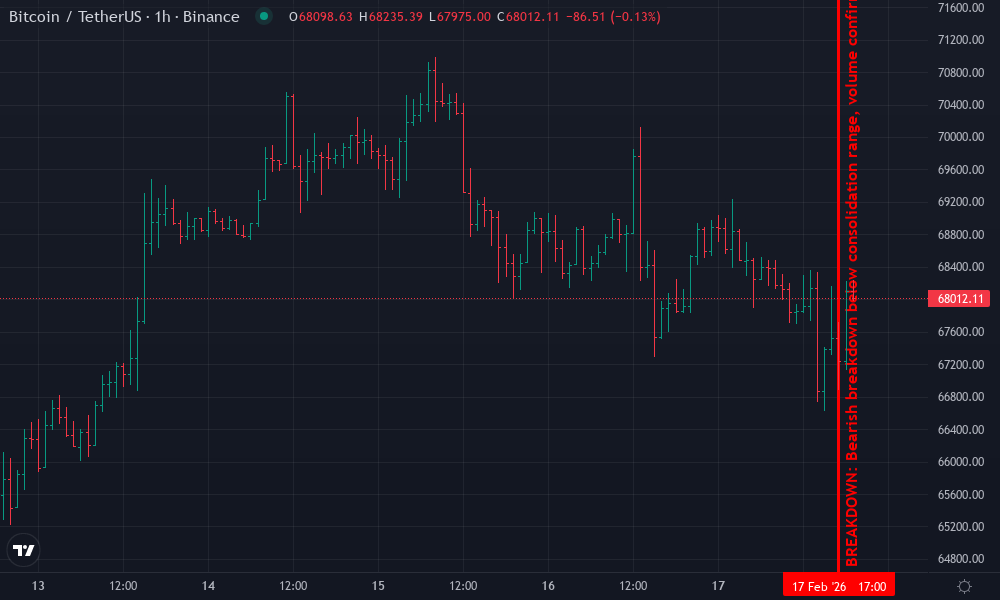
Analysis by Evan Callahan | Symbol: BINANCE:BTCUSDT | Interval: 1h | Drawings: 8
Technical Analysis Summary
As Evan Callahan, my aggressive technical style demands precise markings on this BTCUSDT 1H chart from 2026-02-17. Start by drawing a downtrend line connecting the high at 2026-02-17T15:00:00Z ($110,000) to the low at 2026-02-17T17:30:00Z ($108,500) with high confidence—this captures the sharp reversal. Add horizontal support at $108,500 (strong, 24h low) and $109,000 (moderate bounce zone). Resistance horizontals at $109,800 (recent rejection) and $110,000 (key overhead). Mark entry long zone around $109,200-$109,400 with a green rectangle or long_position tool, profit target at $110,000, stop below $108,500. Use fib retracement from the swing low $108,500 to high $110,000 for pullback levels. Callout volume spike on downside candles around 16:00-17:00 indicating distribution pressure. Arrow down on MACD bearish crossover near 16:30. Rectangle for consolidation range 15:30-16:30 between $109,500-$110,000. Vertical line at 17:00 for breakdown confirmation. Text notes: ‘Aggressive long reload at support’ and ‘High risk tolerance play’.
Risk Assessment: medium
Analysis: High volatility intraday with clear support nearby, but breakdown momentum adds uncertainty; GOAT catalysts support upside bias
Evan Callahan’s Recommendation: Enter aggressive longs at $109,200 with 1:2 RR targeting $110k, high tolerance suits this scalp—scale in on dips!
Key Support & Resistance Levels
📈 Support Levels:
-
$108,500 – 24h low and strong intraday support holding the downside
strong -
$109,000 – Minor bounce level near current price, potential reload zone
moderate
📉 Resistance Levels:
-
$109,800 – Recent candle rejection wick, immediate overhead resistance
moderate -
$110,000 – 24h high and psychological barrier, key breakout level
strong
Trading Zones (high risk tolerance)
🎯 Entry Zones:
-
$109,200 – Aggressive long entry on pullback to minor support amid GOAT-driven BTC strength
high risk
🚪 Exit Zones:
-
$110,000 – Profit target at session high retest
💰 profit target -
$108,500 – Tight stop below strong support to limit downside
🛡️ stop loss
Technical Indicators Analysis
📊 Volume Analysis:
Pattern: spike on downside
Volume climaxes on red candles 16:00-17:30, signaling distribution but potential exhaustion
📈 MACD Analysis:
Signal: bearish crossover
MACD line crossed below signal around 16:30, confirming downtrend momentum short-term
Applied TradingView Drawing Utilities
This chart analysis utilizes the following professional drawing tools:
Disclaimer: This technical analysis by Evan Callahan is for educational purposes only and should not be considered as financial advice.
Trading involves risk, and you should always do your own research before making investment decisions.
Past performance does not guarantee future results. The analysis reflects the author’s personal methodology and risk tolerance (high).
Decentralized sequencing zk elevates this further, distributing power and incentives. Node operators stake $GOATED for sequencing rights, earning BTC fees proportional to performance. This merit-based system, unlike PBFT consensus vulnerabilities, aligns long-term holder interests with network health.

We provide everything you need to build fast.
• GOAT Developer Docs: https://t.co/prtIkrP3Gc
• x402 SDK: https://t.co/HYk7jdWiZ5
• ERC8004:https://t.co/2Axf8E7Jp6
• Live technical support in official community:https://t.co/Z5zWLZ8TZx
Join now and
Developers find fertile ground in zkMIPS’s compatibility, porting EVM tools to build BTC-native DeFi. With 46 GitHub repositories buzzing, dApps for perpetuals, options, and RWAs emerge, all settling on Bitcoin L1. This composability unlocks zk rollups bitcoin scaling beyond simple transfers.
Looking ahead, mainnet looms as the litmus test. If GOATRollup sustains sub-second finality and 1,000 and TPS at Bitcoin’s $109,392.29 price point, it could capture 5-10% of BTC L2 TVL within 18 months. Early metrics from the 2025 testnets support this trajectory: five provers hitting real-time proofs, dashboard yields live, and sequencer sets expanding. For BTC holders, GOATRollup offers a prudent path to yields, blending Bitcoin’s impregnable security with rollup efficiency. As network activity ramps, expect this flywheel to spin faster, rewarding patient capital with native returns unmatched in the ecosystem.
Comparison of GOATRollup vs Other BTC L2s
| Project | Sequencer Model | Yield Source | Security Model | TPS |
|---|---|---|---|---|
| GOATRollup | Decentralized | BTC Fees/MEV | BitVM2/zkMIPS | 1,000 |
| Stacks | Centralized | STX Emissions | PoX | 100 |
| Merlin | Centralized | Bridge Fees | ZK | 500 |
Stakeholders from retail to institutions stand to gain, provided they verify on-chain proofs and diversify exposures. In a maturing BTCFi landscape, GOATRollup’s fusion of technology and economics charts a scalable future for Bitcoin utility.
About the Author