
In the relentless pursuit of blockchain scalability, zkVerify has etched a landmark achievement: verifying over 15 million zero-knowledge proofs on its mainnet as of February 11,2026. This milestone, powered by Horizen Labs, spotlights zkVerify's emergence as the zk proofs verification layer that ZK rollups desperately need. By offloading intensive verification tasks from congested Layer 1 networks, zkVerify slashes costs and boosts throughput, paving the way for mainstream adoption of zero-knowledge technology in DeFi, gaming, and beyond.

At its core, zkVerify operates as a modular Layer 1 blockchain engineered specifically for high-performance ZK proof verification. Unlike general-purpose chains that grapple with the computational heft of ZKPs, this specialized network aggregates verification demands across multiple proof systems and ecosystems. Drawing from insights in the zkVerify Protocol Whitepaper draft, innovations like EIP-196 and EIP-197 have shaped its compatibility with rollups and zkVMs, enabling seamless integration without compromising security.
zkVerify's Cost-Crushing Mechanics for Proof Settlement
The protocol's value shines brightest in its drastic cost reductions. Historical data reveals verification gas costs plummeting by more than 90%, while proving expenses dipped roughly 20% in 2025 alone. Delphi Digital aptly describes it as the universal verification layer for zero-knowledge proofs, a designation backed by real-world savings: up to 91% cheaper verification that could have spared ZK rollups over $42.8 million in 2023. For developers building on Ethereum or Bitcoin rollups, this translates to viable economics for high-volume applications previously stifled by Ethereum's gas fees.
Consider the Binance analysis: zkVerify's architecture batches proofs efficiently, minimizing on-chain settlement overhead. This isn't mere optimization; it's a paradigm shift. Traditional ZK rollups bundle transactions off-chain and post succinct proofs to L1 for finality, but verification remains a bottleneck. zkVerify absorbs this load, verifying proofs at scale and emitting lightweight attestations back to the settlement layer. Its modular design supports diverse proving backends, from Groth16 to newer recursive schemes, fostering interoperability in a fragmented ZK landscape.
Dissecting the 15 Million Proofs Milestone
Reaching 15 million verified proofs underscores zkVerify's production readiness. Platforms like CallScan, which submit 50,000 to 100,000 proofs daily, exemplify its robustness under high-frequency workloads. This volume rivals the aggregate activity of major rollups, yet zkVerify handles it with sub-second finality and negligible costs. The zkVerify blog's 2025 year-in-review highlights how these efficiencies made verifiable computation feasible for enterprise use cases, from institutional privacy solutions to cross-chain bridges.
Horizen Labs' launch announcement via Chainwire emphasized the protocol's edge: cost-effective verification without sacrificing decentralization. Nodes run lightweight verifiers, distributing the workload while maintaining censorship resistance. In a YouTube deep-dive by The Defiant, experts noted zkVerify's novelty in making ZK "cost-effective, stable, and modular" within Web3. For investors eyeing HorizenLabs zkVerify, this traction signals network effects kicking in, as more rollups tap into its verification services.
Unlocking Scalability Bottlenecks in ZK Rollups
ZK rollups, as Horizen explains, compress Layer 2 transactions into validity proofs settled on Ethereum mainnet. Yet, as adoption surges, L1 verification queues balloon, inflating fees during peak demand. zkVerify intervenes as a dedicated ZK rollups proof verification hub, decoupling computation from settlement. This modular zk verifier scalability enables rollups to process thousands of TPS while paying pennies per proof.
Implications ripple outward. DeFi protocols can now embed ZK for private trades without gas wars. Gaming dApps achieve real-time state proofs, unhindered by L1 constraints. Data verification markets, like those powering AI oracles, gain trustless efficiency. A Medium post on zkVerify's ZKP integration for scalability notes reduced data storage needs, aligning perfectly with the blockchain trilemma's demands. By externalizing verification, zkVerify not only accelerates rollups but fortifies their security model against prover centralization risks.
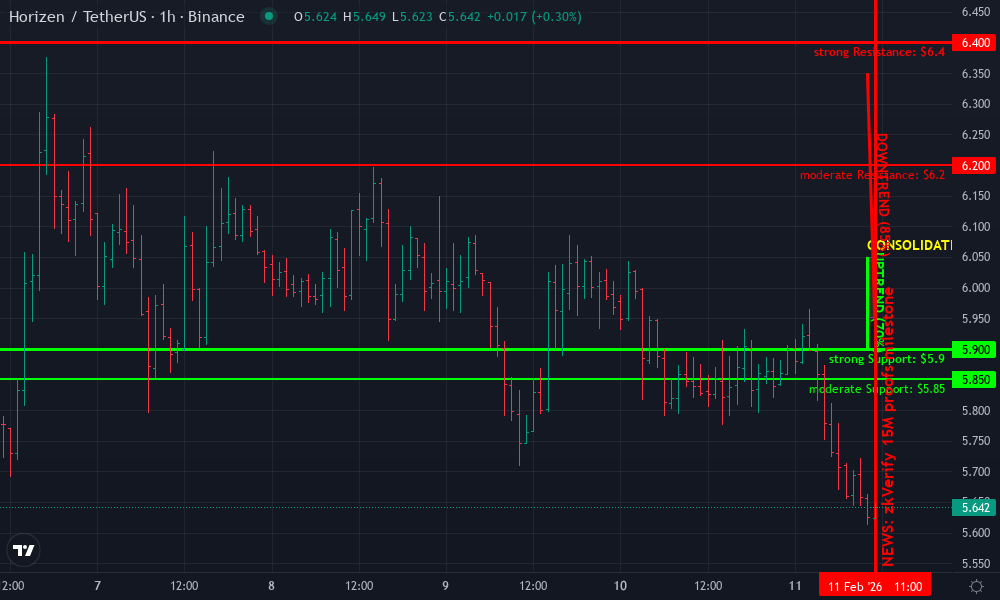
Horizen Technical Analysis Chart
Analysis by Evan Callahan | Symbol: BINANCE:ZENUSDT | Interval: 1h | Drawings: 8
Technical Analysis Summary
Aggressively mark the short-term downtrend from the 6.35 high at 10:35 to the 5.95 low at 11:00 with a bold red trend_line, signaling potential exhaustion. Draw a green uptrend line connecting the 5.90 support swing lows from 10:45 to now for bounce anticipation. Highlight key support at 5.90 with thick horizontal_line (strong), resistance at 6.20 (moderate) and 6.40 (strong) similarly. Rectangle the consolidation zone 10:50-11:00 between 5.95-6.05. Fib retracement from recent high-low pullback. Long position marker at 5.92 entry, profit_target at 6.20, stop_loss 5.85. Volume callout on spike at drop, MACD arrow_mark_down on bearish cross. Vertical_line at 11:10 for zkVerify news impact. Arrow up at support for aggressive buy signal.
Risk Assessment: medium
Analysis: High reward setup on support with fundamental catalyst, but short-term volatility from dump
Evan Callahan's Recommendation: Aggressive long entry now—high tolerance play for 20%+ swing to 6.20+
Key Support & Resistance Levels
📈 Support Levels:
- $5.9 - Strong volume shelf, multiple tests strong
- $5.85 - Breakout invalidation moderate
📉 Resistance Levels:
- $6.2 - Recent swing high, fib 61.8% moderate
- $6.4 - Session high, psychological strong
Trading Zones (high risk tolerance)
🎯 Entry Zones:
- $5.92 - Bounce off strong support + zkVerify catalyst high risk
🚪 Exit Zones:
- $6.2 - Profit target at resistance confluence 💰 profit target
- $5.85 - Tight stop below support 🛡️ stop loss
Technical Indicators Analysis
📊 Volume Analysis:
Pattern: climax selling
Spike on downside suggests exhaustion
📈 MACD Analysis:
Signal: bearish crossover
Momentum fading, divergence potential
Applied TradingView Drawing Utilities
This chart analysis utilizes the following professional drawing tools:
Disclaimer: This technical analysis by Evan Callahan is for educational purposes only and should not be considered as financial advice. Trading involves risk, and you should always do your own research before making investment decisions. Past performance does not guarantee future results. The analysis reflects the author's personal methodology and risk tolerance (high).
Real-world deployments further cement zkVerify's edge. Integrations with platforms like Singularity leverage its high-performance verification for institutional-grade privacy, enabling efficient validation of complex ZK computations. This modular approach extends beyond Ethereum to Bitcoin rollups and other chains, positioning zkVerify as a cross-ecosystem backbone. Developers no longer wrestle with L1 bottlenecks; instead, they submit proofs to zkVerify for rapid attestation, reclaiming resources for innovation.
ZK Proof Verification Costs: zkVerify (90%+ Reduction) vs Ethereum L1 & Polygon (2023-2026 Projections with $42.8M Savings Highlight)
| Year | Ethereum L1 Cost ($M) | Polygon Cost ($M, est. L2) | zkVerify Cost ($M) | Reduction vs L1 (%) | Savings vs L1 ($M) |
|---|---|---|---|---|---|
| 2023 | $47.6 | ~$15-25 | $4.8 | 90%+ | $42.8 💼 |
| 2024 | Projected $60 | Projected ~$20-35 | Projected $6 | 90%+ | Projected $54 |
| 2025 | Projected $80 | Projected ~$25-45 | Projected $8 | >90% | Projected $72+ |
| 2026 | Projected $100 | Projected ~$30-55 | Projected $10 | 91% | Projected $90 (15M Proofs Verified Milestone) |
Quantitative metrics paint a compelling picture. In 2023, ZK rollups hemorrhaged fees on proof settlement; zkVerify's 91% cost slash would have conserved over $42.8 million. Fast-forward to 2026: daily volumes from CallScan alone, 50,000 to 100,000 proofs, demonstrate sustained scalability. This isn't hype; it's measurable progress in gas efficiency, where verification now rivals optimistic rollups in speed without trust assumptions. For portfolio managers, these figures signal reduced volatility in ZK-native projects, as economic viability shores up against market downturns.
Network Effects and Competitive Moat
zkVerify's traction fosters powerful network effects. As more rollups route proofs through its L1, verifier nodes proliferate, driving costs lower via economies of scale. Horizen Labs' design choices, lightweight nodes, multi-proof support, create a defensible moat against copycats. Competitors like general L2 verifiers falter under diverse workloads, but zkVerify's specialization shines in high-throughput scenarios. The Defiant's coverage underscores this: a stable, modular verifier that collapses ZK economics without centralization pitfalls. Investors should note the flywheel: higher volumes attract provers, enhancing liquidity in decentralized proving markets.
Looking ahead, this 15 million milestone accelerates ZK rollups toward the scalability trilemma's holy grail: security, decentralization, and velocity. DeFi yields compound privately; gaming worlds sync states seamlessly; oracles feed AI models with verifiable data. Yet risks linger, prover collusion or quantum threats demand vigilant audits. zkVerify mitigates these through distributed verification, but adoption hinges on seamless SDKs for zkVMs. For those building or investing in modular zk verifier scalability, the protocol offers a prudent bet: proven at scale, with margins for error minimized.
Horizen Labs continues iterating, with whitepaper drafts hinting at recursive proof aggregation for sub-cent verifications. As Ethereum's Dencun upgrade amplifies rollup demand, zkVerify stands ready as the zk proofs verification layer that turns theoretical scalability into operational reality. This isn't just a number; it's the foundation for ZK's next era.
Explore zkVerify's Bitcoin rollups potential



No comments yet. Be the first to share your thoughts!