
Hey traders and DeFi builders, if you're scaling your protocols in 2026, the zkSync Era vs Polygon zkEVM debate is heating up like a bull run in alt season. Both are zk rollups slashing Ethereum's fees and boosting speeds, but when it comes to real-world DeFi performance, one pulls ahead in benchmarks that matter: throughput, finality, costs, and TVL. Let's dive into the data from late 2025 tests and see why zkSync Era is riding the trend for high-volume swaps and lending apps.
Throughput Throwdown: TPS Under the Hood
Picture this: your DeFi app hits peak trading hours with thousands of users swapping tokens. Can your Layer 2 handle it without choking? zkSync Era flexes with a theoretical max of 2,500 TPS, clocking 350 TPS average and peaks at 1,200 TPS. Polygon zkEVM? Solid at 2,000 TPS theoretical, but averages just 180 TPS with peaks of 850 TPS during NFT drops. That's zkSync Era nearly doubling Polygon in observed throughput, perfect for DeFi's relentless transaction firehose.
Why the edge? zkSync's custom eraVM with LLVM compiler optimizes complex ops like token swaps at 71 TPS historically, while Polygon's EVM-equivalent setup lags in real stress tests. For zk rollups DeFi performance in 2026, this means zkSync scales your yield farms without the hiccups.
zkSync Era vs Polygon zkEVM: Performance Benchmarks
| Benchmark | zkSync Era | Polygon zkEVM |
|---|---|---|
| Theoretical TPS | 2,500 | 2,000 |
| Average TPS | 350 | 180 |
| Peak TPS | 1,200 | 850 |
| Initial Confirmation | 1-2 seconds | 1-3 seconds |
| Full Finality | 10-15 minutes | 15-30 minutes |
| Transfer Fee | $0.005 | $0.008 |
| Swap Fee | $0.11 | $0.14 |
| NFT Mint Fee | $0.19 | $0.24 |
Finality and Fees: The DeFi Speed Demons
Fast confirmations keep traders glued; slow ones send them running. zkSync Era nails 1-2 second initial confirmations and 10-15 minute full finality, outpacing Polygon's 1-3 seconds initial and 15-30 minute full. In DeFi, where arbitrage bots feast on seconds, zkSync's quicker settlements mean more opportunities captured, less slippage.
Fees seal the deal. zkSync Era's $0.005 simple transfers, $0.11 swaps, and $0.19 NFT mints undercut Polygon's $0.008, $0.14, and $0.24. Both crush Ethereum's gas guzzlers with 90% and cuts, but zkSync's thrift edges out for high-frequency DeFi like perpetuals or liquidity provision. Manage the risk, ride the savings!
zkSync Era Technical Analysis Chart
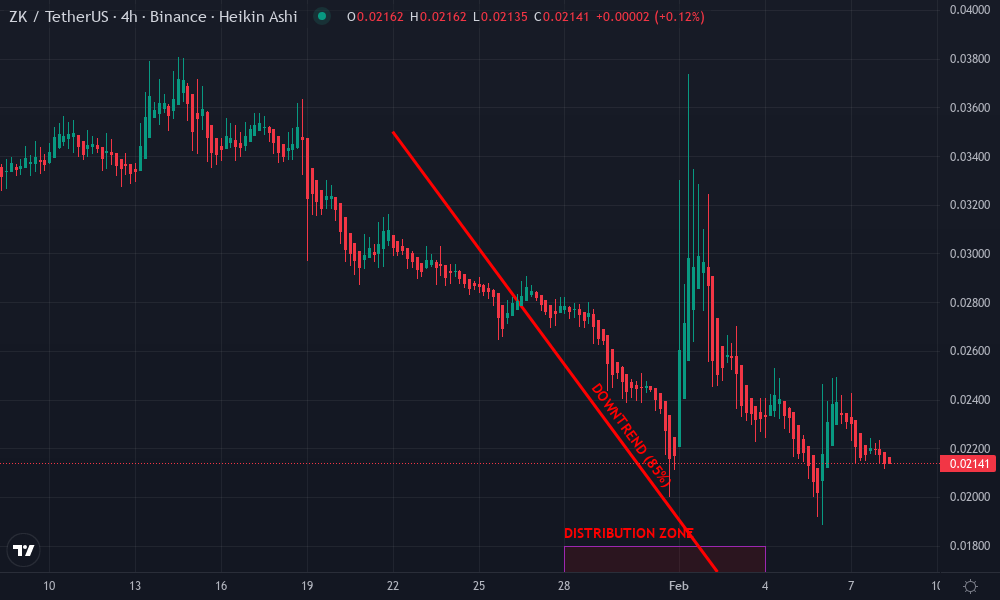
Analysis by Jenna Morales | Symbol: BINANCE:ZKUSDT | Interval: 4h | Drawings: 6
Technical Analysis Summary
Hey traders, Jenna here! On this ZKUSDT daily chart, draw a bold red downtrend line connecting the Jan 22 peak at 0.035 to the Feb 7 low at 0.0095 – that's our aggressive bear channel to watch for breaks. Add horizontal lines at key support 0.0090 (strong, green) and resistance 0.0150 (strong, red). Sketch a fib retracement from the Jan 16 low to Jan 22 high for potential bounce levels at 0.0236 (38.2%) and 0.0288 (61.8%). Rectangle the consolidation zone Jan 28-Feb 4 between 0.012-0.018. Mark volume spikes with green arrows up on the big red candles for distribution. Long entry zone at 0.0095 with stop below 0.0085, target 0.0150. Ride the trend if it snaps up on zkSync hype!
Risk Assessment: high
Analysis: Volatile crypto L2 token in downtrend but oversold with strong zkSync Era catalysts like superior TPS/TVL vs competitors; high reward potential justifies risk
Jenna Morales's Recommendation: Go long aggressively on bounce, scale in at support – zkSync dominance incoming!
Key Support & Resistance Levels
📈 Support Levels:
- $0.009 - Recent swing low with volume support, key hold level strong
- $0.008 - Psychological and prior low extension moderate
📉 Resistance Levels:
- $0.012 - Near-term overhead from Feb consolidation moderate
- $0.015 - Strong resistance from Jan 28 gap strong
Trading Zones (high risk tolerance)
🎯 Entry Zones:
- $0.01 - Aggressive long on support bounce, high reward zk fundamentals high risk
- $0.011 - Pullback entry if minor uptrend holds medium risk
🚪 Exit Zones:
- $0.015 - First profit target at resistance 💰 profit target
- $0.009 - Tight stop below support 🛡️ stop loss
- $0.02 - Extended target on breakout 💰 profit target
Technical Indicators Analysis
📊 Volume Analysis:
Pattern: climax selling on breakdown
High volume on red candles Jan 28-Feb 4 signals distribution, potential exhaustion
📈 MACD Analysis:
Signal: bearish but diverging
MACD line below signal with histogram contracting, bullish divergence vs price
Applied TradingView Drawing Utilities
This chart analysis utilizes the following professional drawing tools:
Disclaimer: This technical analysis by Jenna Morales is for educational purposes only and should not be considered as financial advice. Trading involves risk, and you should always do your own research before making investment decisions. Past performance does not guarantee future results. The analysis reflects the author's personal methodology and risk tolerance (high).
TVL Battle: Where DeFi Dollars Deploy
TVL doesn't lie; it's the market's vote of confidence. zkSync Era boasts $1.11 billion TVL, peaking at $1.6 billion last year, dwarfing Polygon's $120 million and $190 million peak. This gap screams adoption: more protocols, bigger liquidity pools, stickier users. zkSync's EVM compatibility lets devs port Ethereum contracts seamlessly, fueling that TVL surge for zksync DeFi scalability.
Polygon zkEVM's EVM-equivalence is close, but tweaks needed slow migrations. In zkEVM benchmarks for DeFi, zkSync's lead shows in live apps like complex swaps hitting 2.5-second finality. Traders, if you're building or deploying capital, this TVL momentum signals zkSync as the 2026 frontrunner.

EVM compatibility adds nuance: zkSync's full compatibility wins for quick ports, while Polygon's equivalence shines for Ethereum purists. But benchmarks tilt heavily toward zkSync for raw DeFi horsepower.
Let's put these specs to work in actual DeFi scenarios. Imagine deploying a high-frequency trading bot or a yield optimizer that crunches multisig approvals and flash loans. In late 2025 benchmarks from BlockEden, zkSync Era handled complex swaps at 71 TPS with 2.5-second finality, leaving Polygon zkEVM trailing in similar tests. For zk rollups DeFi performance 2026, this translates to tighter spreads and higher yields without the lag that kills momentum trades.
DeFi Stress Tests: Swaps, Lending, and Liquidity Pools
Take lending protocols: zkSync Era's lower fees mean borrowers pay less on repeated collateral adjustments, stacking up savings in volatile markets. A simulated AMM with 10,000 swaps saw zkSync average $0.11 per trade versus Polygon's $0.14, compounding to serious edges over a week's trading. Liquidity providers love it too; faster finality reduces impermanent loss exposure during pumps.
Polygon zkEVM fights back with robust tooling for Polygon ecosystem integrations, but zkEVM benchmarks DeFi reveal zkSync's throughput king status. During peak NFT mints tied to DeFi gamification, zkSync's 1,200 TPS peak kept frontends smooth, while Polygon's 850 TPS spiked queues. Traders, if your app thrives on volume, zkSync Era zksync defi scalability is the no-brainer.
DeFi-Specific Benchmarks: zkSync Era vs Polygon zkEVM (Token Swaps TPS/Fees, Lending Tx Finality, LP Provision Costs) in 2026
| Metric | zkSync Era | Polygon zkEVM |
|---|---|---|
| Token Swaps TPS (Avg / Peak) | 350 / 1,200 | 180 / 850 |
| Token Swap Fees | $0.11 | $0.14 |
| Lending Tx Finality (Full) | 10-15 minutes | 15-30 minutes |
| LP Provision Costs (NFT Mint proxy) | $0.19 | $0.24 |
TVL tells the adoption story. With zkSync Era at $1.11 billion versus Polygon's $120 million, real DeFi dollars flow where performance shines. zkSync hosts buzzing protocols pulling in institutional TVL amid the $28B zk rollups boom, per recent analyses. Polygon lags, but its sidechain roots offer hybrid plays for devs eyeing multi-chain futures.
Dev Dilemma: Building on zkSync or Polygon?
You're a builder eyeing zkEVM for DeFi. zkSync's EVM-compatible eraVM lets you lift-and-shift Solidity contracts, deploy in days. Polygon's equivalence demands opcode tweaks, slowing MVPs. Costs? Polygon zkEVM deploys 90-95% cheaper than L1, but zkSync's ecosystem grants and LLVM speedups tip the scales for production apps.
Risk management is key: zkSync's Type 4 architecture with LLVM crushes complex ops, but watch for centralization risks in sequencers. Polygon spreads validity proofs wider, appealing to decentralization purists. Still, for 2026 zk rollups DeFi performance, zkSync's live metrics scream winner. Check Chainspect's TPS leaderboards; zkSync dominates real-time speeds.
Looking ahead, both evolve fast. zkSync eyes 20k TPS upgrades, Polygon pushes aggregator stacks. But today's data crowns zkSync Era for DeFi horsepower. Deploy there, capture the liquidity wave, and watch your protocols scale without friction. Ride the zk trend, traders; the benchmarks don't lie.



No comments yet. Be the first to share your thoughts!